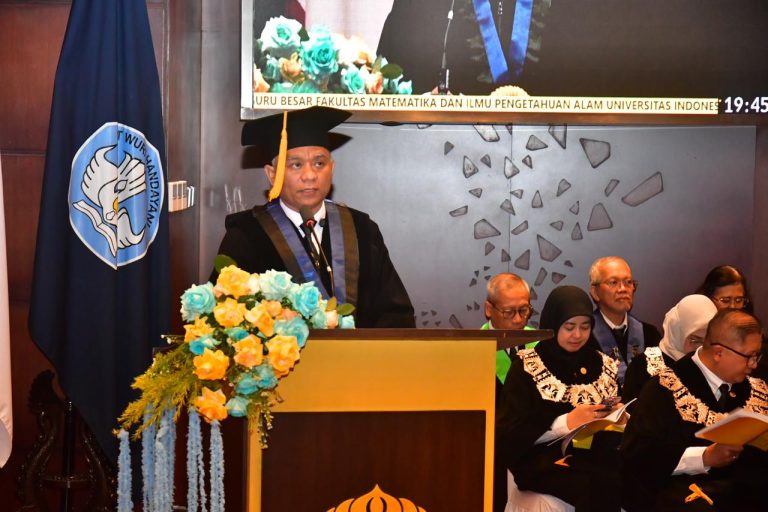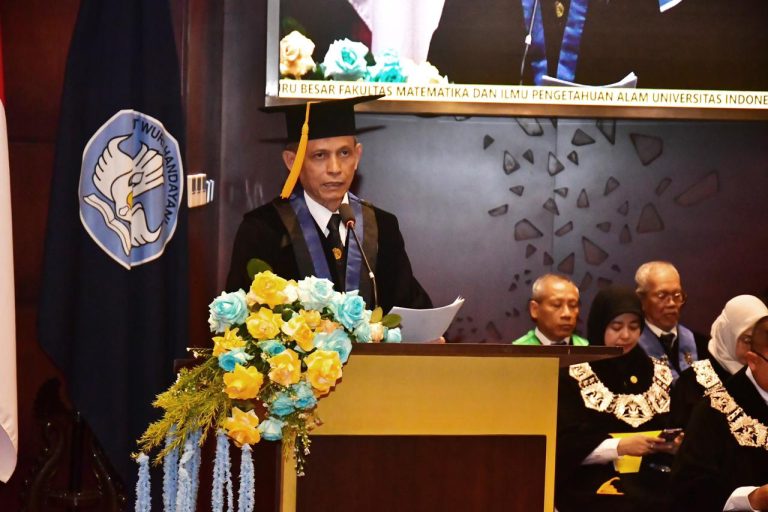
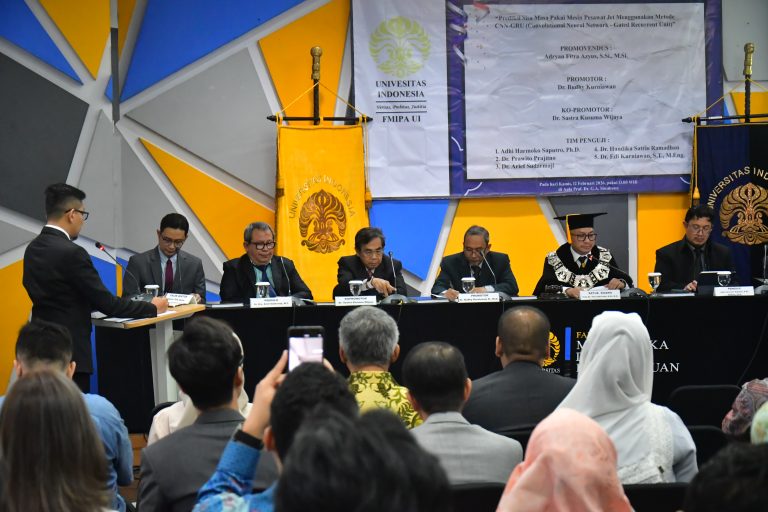
Keselamatan penerbangan menjadi perhatian utama di era transportasi udara modern. Pada Kamis (12/2), Adryan Fitra Azyus resmi meraih gelar doktor di FMIPA Universitas Indonesia (UI) dengan predikat sangat memuaskan setelah mempresentasikan disertasi berjudul “Prediksi Sisa Masa Pakai Mesin Pesawat Jet Menggunakan Metode CNN-GRU (Convolutional Neural Network – Gated Recurrent Unit)”. Sidang terbuka digelar di Aula Prof. Dr. Siwabessy, FMIPA UI, dan dipimpin oleh Dekan FMIPA UI, Prof. Dr. Tito Latif Indra.
Penelitian ini lahir dari tantangan besar dalam keselamatan penerbangan, khususnya terkait mesin pesawat jet tipe turbofan yang beroperasi dalam kondisi ekstrem dan rentan mengalami degradasi material. Banyak kecelakaan pesawat berawal dari kerusakan mesin akibat prosedur perawatan yang tidak tepat atau kegagalan inspeksi. Meski bencana jarang terjadi, dampaknya menimbulkan tekanan besar bagi industri dan otoritas penerbangan untuk meningkatkan regulasi dan pengawasan.
Secara fisik, degradasi mesin terjadi akibat akumulasi perubahan material seperti fouling, erosi, dan creep, yang menimbulkan retakan mikro dan perubahan struktur logam seiring waktu. Sayangnya, metode perawatan konvensional sering gagal mendeteksi tanda awal kerusakan karena mengasumsikan perilaku linear pada sistem yang sebenarnya non-linier. Hal ini menjadi tantangan besar dalam memprediksi sisa usia pakai atau Remaining Useful Life (RUL) mesin secara presisi.
Dalam penelitiannya, Adryan berupaya menjembatani kesenjangan antara prinsip fisika kegagalan dan teknologi modern dengan mengembangkan metode prediksi RUL berbasis Deep Learning yang akurat dan efisien. Ia menggabungkan prinsip Predictive Maintenance (PdM) dengan arsitektur hibrida CNN-GRU, yang mampu mempelajari pola tersembunyi dalam data sensor mesin sekaligus memprediksi riwayat degradasi. CNN mengekstrak korelasi antar-sensor untuk memahami hubungan spasial, sedangkan GRU memodelkan degradasi temporal sehingga riwayat performa mesin tercatat secara tepat.
“Penelitian ini bukan sekadar soal menghitung angka atau prediksi mesin. Tujuan utamanya adalah memastikan keselamatan penumpang dan efisiensi operasional maskapai dengan memprediksi kerusakan sebelum terjadi,” ujar Adryan. Pendekatan ini disebut Spatio-Temporal karena mampu menangkap hubungan fisik mesin dalam ruang dan waktu secara bersamaan.
Penelitian ini memanfaatkan dataset C-MAPSS dari NASA, yang menyediakan data run-to-failure dan memodelkan interaksi antar-komponen mesin berdasarkan prinsip energi dan massa. Data ini memungkinkan model belajar pola degradasi nyata selama operasi mesin, berbeda dari dataset lain yang hanya fokus pada kontrol atau dinamika terbang.
“Dengan teknologi CNN-GRU ini, kita bisa membaca pola degradasi mesin yang biasanya tersembunyi dari inspeksi manual, sehingga pemeliharaan bisa dilakukan tepat waktu dan lebih efisien,” tambah Adryan.
Hasil penelitian menunjukkan bahwa arsitektur CNN-GRU mampu menangani noise tinggi pada data operasional nyata, yang sering gagal diatasi metode konvensional, serta dapat beradaptasi dengan enam kondisi operasi berbeda. Penggunaan GRU dua-gate membuat pelatihan model 11,98% lebih cepat dibanding LSTM standar industri, tanpa mengurangi akurasi, sehingga memungkinkan implementasi prediksi RUL secara real-time dengan beban komputasi minimal.
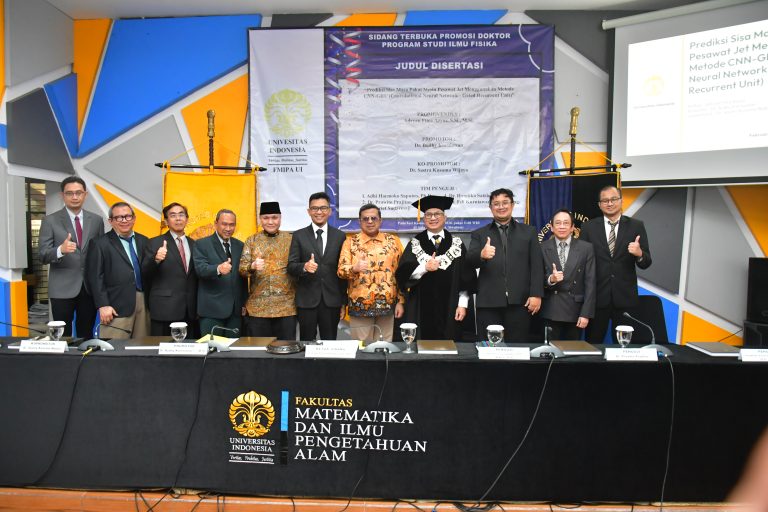
Promotor penelitian ini, Dr. Budhy Kurniawan, menekankan bahwa inovasi ini memberikan kontribusi nyata bagi industri penerbangan karena dapat membantu operator maskapai meminimalkan risiko kerusakan mesin dan mengoptimalkan jadwal perawatan. Ko-promotor Drs. Sastra Kusuma Wijaya, Ph.D., menambahkan bahwa hasil penelitian ini juga mendukung keberlanjutan industri dengan mengurangi limbah material akibat perawatan berlebihan. Adryan menargetkan teknologi ini dapat diterapkan dalam sistem manajemen armada pesawat secara real-time, sehingga operator dapat melakukan pemeliharaan sebelum kerusakan terjadi.
Acara sidang terbuka ini turut dihadiri Kepala Badan Penyelenggara Jaminan Produk Halal (BPJPH) RI, Dr. Haikal Hassan, ST., MT., serta Dewan Penasihat Masyarakat Ekonomi Syariah (MES) sekaligus mantan Presiden Direktur Bank Muamalat, DR (HC) Ahmad Riawan Amin. Prestasi ini mencerminkan komitmen FMIPA UI dalam mengembangkan penelitian yang relevan dengan tantangan industri dan masyarakat, sekaligus memperkuat reputasi fakultas sebagai pusat keunggulan ilmiah dan inovasi teknologi di tingkat nasional maupun internasional.