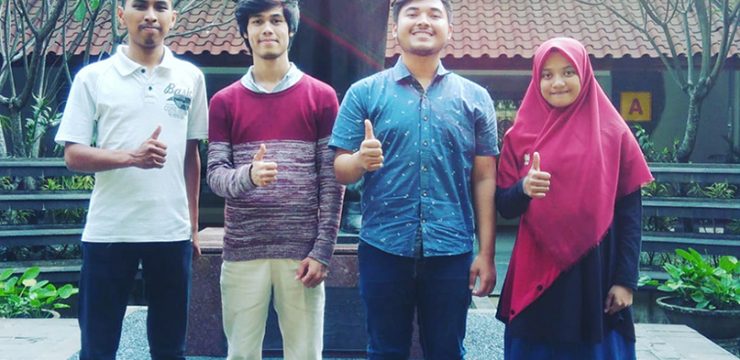
Four students from the Physics Department of the Faculty of Mathematics and Natural Sciences, University of Indonesia (FMIPA UI), have proposed a solution to address drought and difficulties in obtaining clean water by utilizing resistivity technology.
The four students are Ade Rama Tanjung Putra (Class of 2015), Luthfan Togar Harahap (Class of 2014), Miftahul Umam (Class of 2017), and Tiva Rahmita (Class of 2017).
The UI students’ initiative was implemented in Sirnajaya Village, Bogor, which is experiencing a shortage of clean water. This forces residents to walk 5-6 km to obtain clean water.
The benefits of implementing the resistivity method have been felt by residents, who have successfully identified potential wells as water sources close to their homes. Ade, the team leader, claims that this resistivity method can accurately predict the location of water flow layers, thus minimizing drilling costs due to the risk of incorrect well drilling locations.
Ade explained that the villagers’ difficulties extend beyond the 5-6 km walk; to obtain clean water, they also have to construct pipes along this distance. And not all residents can afford to install them due to economic constraints.
Furthermore, Ade continued, another obstacle is that the spring water the community uses is very cloudy and tends to be muddy, even though the water is used for drinking, bathing, and even cooking.
During the program, the UI Faculty of Mathematics and Natural Sciences students conducted geomorphological surveys and location markings, data acquisition using the resistivity method, data processing and interpretation, and resistivity and topographic mapping.
The research results indicated a potential water source near the mosque’s waqf land, suggesting potential drilling in that area. The discovery of this potential well will be followed by drilling to begin the construction of a water source near the residential area of Sirnajaya Village, Bogor.
“The application of this resistivity method has great potential for sustainability, namely by replicating the same program in other areas facing similar problems. It is hoped that this work will assist the government in realizing the availability and sustainable management of clean water for all Indonesians,” explained Ade.