Depok, September 7, 2026 — Artificial intelligence (AI) is increasingly being used to support research and academic writing. However, its use still requires students to critically evaluate information and understand the boundaries and ethics of academic practice.
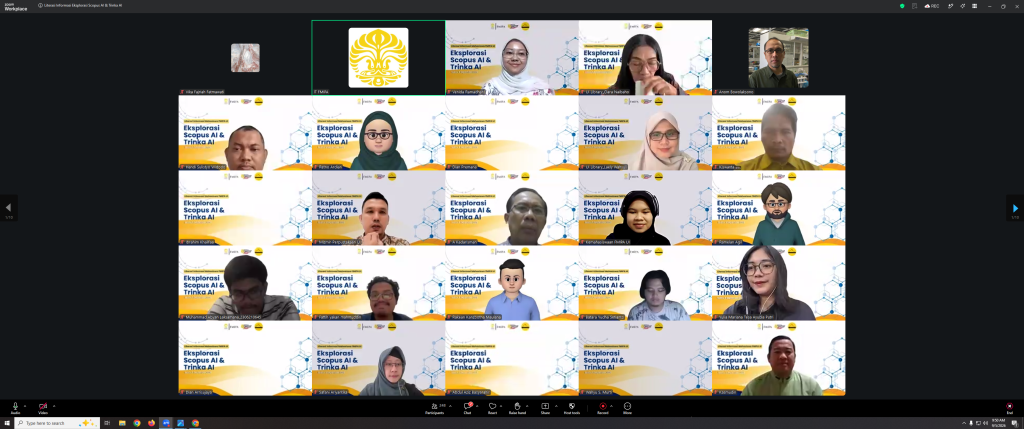
This was one of the focuses of the Information Literacy session themed “Exploring Scopus AI and Trinka AI,” organized by the Faculty of Mathematics and Natural Sciences, Universitas Indonesia (FMIPA UI), on Saturday (September 5, 2026). Held online via Zoom, the session was attended by approximately 280 participants, primarily students preparing research proposals, final projects, and other academic activities.
Through this activity, students were introduced to Scopus AI as a tool to search for and explore scientific literature relevant to their research topics. Meanwhile, Trinka AI was introduced as a tool to support the process of writing and editing academic works.
The Scopus AI session was delivered by Laely Wahyuli, S.S., M.Hum., while the Trinka AI session was delivered by Mizmir, S.Hum. Both sessions provided an overview of how advancements in AI technology can be utilized to assist students in finding scientific information and developing academic works.
However, the use of AI does not replace the role of students in understanding and processing information. The ability to assess the relevance and accuracy of sources remains essential to ensure that the technology is used as a tool to support the research process, rather than as a substitute for academic thinking.
FMIPA UI Vice Dean Prof. Anom Bowolaksono, Ph.D., said that academic processes in the field of science do not stop at activities in the laboratory or field. The data obtained needs to be compiled, analyzed, and developed into scientific writing.
“We are in the field of science, and our work does not only take place in the laboratory or in the field to collect data. What matters is how we then bring the data together, organize it, and analyze it into a written work,” said Prof. Anom.
Therefore, according to Prof. Anom, students need to develop the ability to utilize various sources of information to support their learning and research. The development of AI should also be accompanied by an understanding of how to use the technology appropriately and responsibly.
In addition to introducing AI technology, the activity provided an overview of the services and information resources available at the Universitas Indonesia Library. UI Library Services Coordinator Dra. Kalarensi Naibaho, M.Hum., CDILS., introduced various services and facilities that students can utilize to support their academic and research needs.
The activity was conducted interactively through a discussion session. Participants raised questions about literature searches, the use of information resources, and the application of AI in preparing academic works.
This Information Literacy activity was part of FMIPA UI and the UI Library’s efforts to strengthen students’ ability to access, evaluate, and utilize information effectively and responsibly.
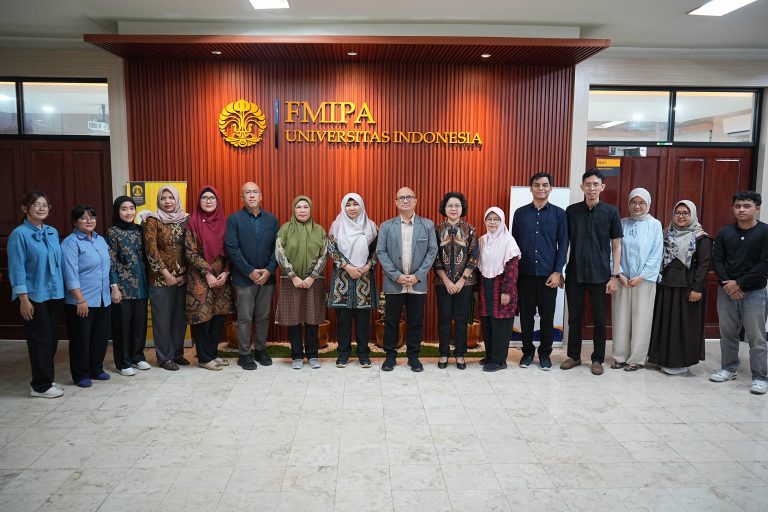
To conclude the activity, FMIPA UI presented certificates to the speakers as a token of appreciation. The certificates were presented by Dr. Yulia Mariana Tesa Ayudia Putri, Assistant Manager for Student Achievement and Ecosystem Development at FMIPA UI.