


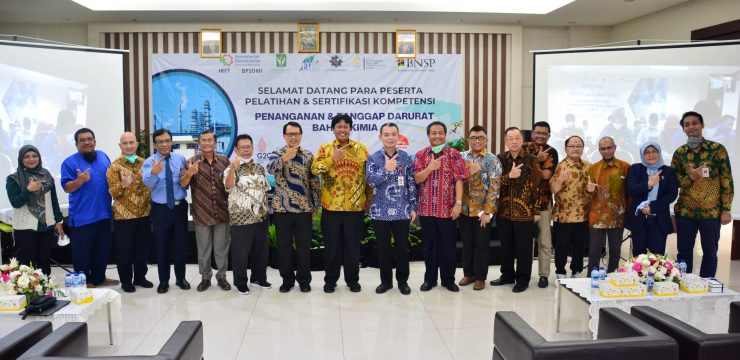
The Faculty of Mathematics and Natural Sciences, University of Indonesia (FMIPA UI), Ministry of Industry of the Republic of Indonesia (Kemenperin RI) through the Directorate General of Industrial Human Resources Development and the Industrial Chemical Professional Certification Institute held “Training and Certification of Competence in Handling and Emergency Response to Chemical Materials”.
The training took place on July 13, 2022, in two locations simultaneously, namely at the Multi-Discipline Research Laboratory Building of the Faculty of Mathematics and Natural Sciences, UI – PT Pertmana, UI Depok Campus, West Java, and also the UI Salemba Campus, Jakarta.
“We have high hopes that through this program, we can realize Superior Human Resources for Advanced Indonesia towards Golden Indonesia 2045,” said Arus Gunawan, Head of the Industrial Human Resources Development Agency (BPSDMI) of the Ministry of Industry.
“Competency-based training is one of our hopes for advancing the industry. Competent human resources will propel the industry forward,” he stressed.
Tirta Wisnu Permana, Head of the BPSDMI Training Center, added that industrial competency is a crucial pillar of the manufacturing industry. This aligns with the BPSDMI “Triple Skilling” program, which includes skilling, reskilling, and upskilling activities.
“The difference lies in the participant qualifications, which are ultimately achieved through recognition of competency from BNSP, the body authorized to provide recognition by awarding competency certificates,” explained Tirta Wisnu Permana.
Prepare Superior Human Resources 4.0
Dean of FMIPA UI Dede Djuhana, Ph.D., on the same occasion explained that his institution, through the Institute of Applied Sciences, continues to provide support to government institutions in improving human resource competency.
“This session has 120 participants, spread across the UI Depok and UI Salemba campuses. The main topic is Chemical Emergency Management, specifically chemical inventory. The goal is to reduce chemical-related accidents,” he explained.
The Director of Upstream Chemicals at the Ministry of Industry, Fredy Juwano, added, “In emergency response (to chemical disasters), industry must not only prepare chemical mitigation documents but also prepare work units to handle disasters.”
Regarding work units, Fredy added, trained and competent human resources are needed. “We are collaborating with universities and LSPs to train individuals to be competent and certified,” he said.
Terkait sertifikasi, Komisioner Badan Nasional Sertifikasi Profesi (BNSP) Bonardo Aldo Tobing memberikan apresiasi atas penyelenggaraan pelatihan ini sebagai upaya mewujudkan SDM Indonesia yang unggul.
“BNSP greatly appreciates all efforts to ensure the competence of Indonesian human resources, particularly in chemical handling. I believe this is crucial because it relates to safety,” Bonardo Aldo emphasized.
“We support implementation, training, and certification. This is the first step in ensuring our human resources are competent and proven. So, it’s not just about claiming competence, but also about providing proof,” he added.
He hopes that this certification competency can serve as a guarantee of quality, ensuring that human resources in the chemical handling sector can reduce all existing risks related to chemicals.
The training program has received positive feedback from industry practitioners. Ridwan Adipoetra, Secretary General of the Indonesian Chemical Industry Federation, stated, “We fully support the program to improve the performance of Indonesian human resources, especially the industrial workforce.”
“We have collaborated with academics and industry practitioners, and with the assistance of regulators and the Ministry of Industry, we are helping to make this workforce upscaling a reality. This is one of the priorities of Making Indonesia 4.0,” said Ridwan.
The importance of improving human resources, especially in B3 hazard mitigation, also received support from Hanggara Sukandar, President Director of Trincio Material Indonesia.
“Industry-wise, development is rapid. This must be matched by the competence of those who carry it out, and frankly, the industry needs competent employees, proven by competency certificates,” said Hanggara.
“This is a positive activity. We support the Ministry of Industry and the University of Indonesia in assisting industry. This supports industrial development,” he concluded.


