The citizen science movement or citizen science has been popular in Indonesia since 2014. This movement emphasizes the power of citizens in collecting data for a specific mission, one of which is biodiversity conservation. Indonesia is well known as a country rich in biodiversity. Unfortunately, biodiversity conservation is often eroded by the flow of development, especially in urban areas such as the Jabodetabek area. However, there are still green spaces that are habitats for various types of urban wildlife. One of the easiest to find is butterflies.
Butterflies are one of the pollinating agents of plants that play a role in providing ecosystem services for urban environments. In fact, butterflies play a role as bio-indicators, meaning that the presence of butterflies can be a benchmark for the health of urban ecosystems. Currently, butterfly observations or butterfly watching not yet very popular in Indonesia. Therefore, RCCC-UI in collaboration with Tambora Muda and through funding by SEAMEO BIOTROP, introduced a movement called KupuKita as a citizen science movement that popularizes butterfly observation starting from each person’s yard. Only with a gadget and complete guide provided through platform http://kupukita.org, residents can observe butterflies at any time independently.
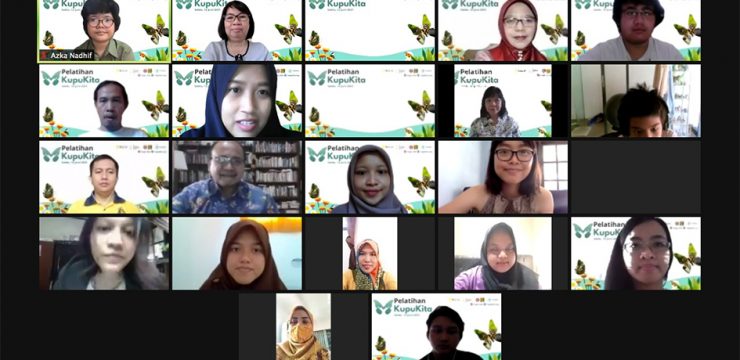
To introduce KupuKita activities and also build a network of butterfly observers in Jabodetabek and its surroundings, KupuKita has conducted an inaugural training attended by 30 participants from Jabodetabek and West Java with various age and job backgrounds. Starting from young participants who are still in elementary school to students, private employees, housewives and photographers. The inaugural training was conducted for 2 days online via Zoom on June 12-13, 2021.
The training activity was opened by a welcoming speech from SEAMEO-BIOTROP, Ir. Sri Widayanti M.Si who is also part of the KupuKita team, as well as a welcoming speech from the Manager of Research and Community Service of FMIPA-UI, Prof. Dr. Ivandini T. Anggraningrum, M.Si. According to Mrs. Sri and Mrs. Ivandini, this movement is considered important and can be carried out strategically during the current pandemic. For example, while gardening, residents can also observe butterflies.
On the first day of training, Dr. Nurul Laksmi Winarni gave a presentation on KupuKita activities which included the objectives of KupuKita activities, the facilities provided by KupuKita for residents and also the benefits obtained by residents when participating in KupuKita activities. In addition, there was a presentation from a butterfly expert from the LIPI Biology Research Center, Dr. Djunijanti Peggie about butterflies in urban areas and also a presentation on the experience of observing butterflies by the young butterfly observer, Azka Nadhif Keandra. “Don’t be afraid to provide a habitat for butterflies. For example, an orange tree at home. When a butterfly lays eggs, the metamorphosis process can be observed at the same time,” said Mrs. Peggie. Responding to questions about butterfly observation times from participants, according to Nadhif, butterflies can be observed in the morning, afternoon, and evening. Usually, in the afternoon, butterflies have started looking for a place to rest. In closing, the KupuKita team also provided a technical explanation regarding the procedures for using the KupuKita platform as provisions for participants in participating in KupuKita activities in the future.
The second day of training continued with independent data collection by the training participants which was carried out from their respective homes. The participants were invited to try out platform KupuKita is also guided by the KupuKita team through Whatsapp Group dalam penggunaan platform that have been provided and in identifying butterflies. “The training has a clear purpose with the readiness of the data collection devices. Although the challenge is to understand the names of butterflies in scientific language, I feel very appreciated when the names and photos (taken during butterfly observations) appear on the website and are included in the butterfly distribution map in Jabodetabek. This means that our activities have contributed to creating a healthier and better living environment,” said Indrawan Miga as an active training participant and also a teacher at the Ants the Natural School.
Meanwhile, independent data collection was conducted for 7 days after the training to improve the participants’ abilities and experiences in observing butterflies. “I am very happy to be involved and meet people who concern with butterfly observations. Moreover, we are also guided by a team that is indeed an expert in their field. So we feel that we are not in the wrong place. We often encounter butterflies. It would be a shame if we didn’t recognize them. I hope KupuKita can be a driving force for the movement citizen science in the field of butterflies. Birds done, now it’s the turn of butterflies! There are actually many people out there who are interested in recognizing butterflies. They just don’t know where to go. Hopefully the KupuKita movement will be better known and continue to be enthusiastic as a pioneer in popularizing butterfly observation among the general public,” said one of the training participants, Hening Swastikaningrum, a freelance writer dan juga pengamat kupu aktif.