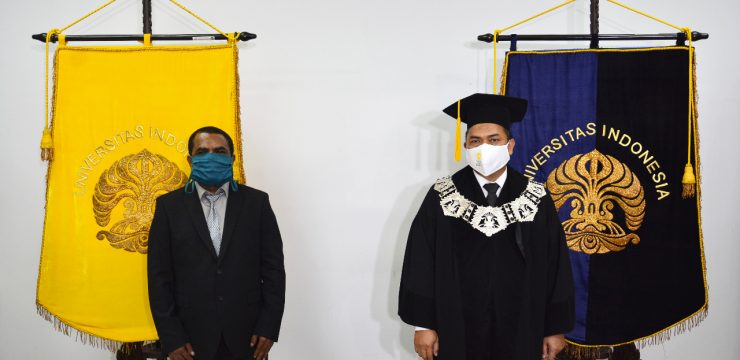
Maikel Simbiak, earned a doctorate in biology from the Faculty of Mathematics and Natural Sciences, University of Indonesia, after successfully completing his research entitled Ethnoecology and Ethnobotany of Indigenous Tribes Around the Wasur Merauke National Park Area, Papua.
At the open session of the Doctoral Promotion of the Biology Postgraduate Program, held by FMIPA UI on Tuesday (11/08/2020), Dr. Maikel Simbiak explained that in his research he explored the perception space of landscape ethnoecology and ethnobotany knowledge with various approaches to understand the local community’s conception of their natural environment holistically.
The introduction and utilization of various resources, both physical and biotic, always shows a relationship between kosmos, corpus, And praxis.
“This research was conducted in four stages, taking into account the distinct differences between the dry and wet seasons and their relationship to the subsistence activities of indigenous communities in the study locations,” said Dr. Maikel.
In general, this research aims to explore the perceptions and conceptions of indigenous communities around the TNW area regarding their natural environment and its use to be integrated into conservation efforts from the perspective of biological and cultural diversity (biocultural).
In addition, Dr. Maikel continued, ethnobiological studies conducted in the Wasur National Park area showed that the traditional ecological knowledge system of this indigenous tribe had not been fully explored, including through this study.
Therefore, collaboration between researchers and practitioners in multidisciplinary, interdisciplinary, and transdisciplinary studies is very necessary to produce indicators that can be used as a basis for approaches to solving conservation problems from biological and cultural aspects that are truly contextual so that they can be applied to determine the direction of management of the TNW area in the three pillars of sustainable development.