


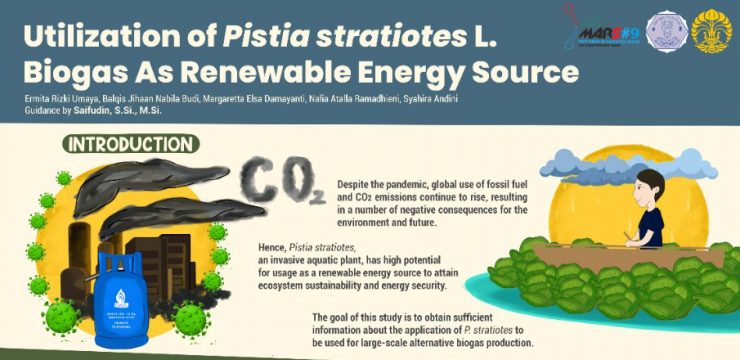

Various innovations to find alternative solutions for new and renewable energy sources that are environmentally friendly in order to reduce the use of fossil fuels, continue to be pursued by many parties. The reason is, the use of fossil fuels causes various global problems that affect human survival, both in terms of energy security and ecosystem security. One of the impacts on the environment is an increase in combustion gas emissions (pollutants) which cause the greenhouse gas effect and of course affect air quality. In addition, fossil energy has limited reserves, and cannot be renewed.
With this background, a team of students from the Department of Biology, Faculty of Mathematics and Natural Sciences, University of Indonesia (FMIPA UI) class of 2018 consisting of Ermita Rizki Umaya, Balqis Jihaan Nabila Budi, Margaretta Elsa Damayanti, Nalia Atalla Ramadhieni, and Syahira Andini came up with a new and renewable energy innovation based on organic waste from watercress plants (Pistia stratiotes) as an alternative solution to overcome this problem.
Under the guidance of Saifudin, M.Si., the team put forward an idea entitled Utilization of Pistia stratiotes L. Biogas As Renewable Energy Source it is in a scientific paper which is also presented in the form of a poster and video with visual content that is interesting and easy for the public to understand.
To the FMIPA UI Public Relations team, Saifudin said that an alternative approach in the form of renewable energy could be a solution, one of which is by using biogas from plant biomass, such as Pistia stratiotes. It is known that the hemicellulose content P. stratiotes acts as a substrate in the fermentation process, thus producing methane gas (CH4which is known to be the main component of biogas.
Since 1980 until now, according to him, research related to biogas production has used P. stratiotes has experienced various developments related to its potential and production methods, but has an information gap (information gap) regarding which method is best, and its application in the community landscape.
“The research we are conducting is in the form of review previous studies and aims to obtain sufficient information for application. P. stratiotes in large-scale biogas production,” said Saifudin.
Regarding how it works, the lecturer with expertise in botany explained that biogas is formed by… P. stratiotes sebagai bahan dasar diawali dengan pre-treatment to remove impurities. Next, the process is carried out anaerobic digestion yang merupakan serangkaian proses fermentasi. Proses ini dapat dilakukan dengan berbagai variasi metode, yakni batch, continuous, photofermentation, separate hydrolysis and fermentation (SHF), dan semi-batch. Proses-proses tersebut akan menghasilkan produk utama biogas, yakni gas metana (CH4), karbon dioksida (CO2), dan produk sampingan lainnya.
“Among the five methods, the team concluded that semi-batch is the best method for producing biogas for large-scale applications. In addition to being applicable, we consider the method semi-batch can meet economic value so as not to burden the community when the gas produced is ready to be distributed,” he added.
The team then brought this brilliant idea to the international event “MARS9 Paper Competition” organized by Yogyakarta State University.
And this innovation led the team to the final round with the winner to be decided on May 20, 2022.
“After passing the previous two stages, namely abstract and full paper selection, the team has now successfully entered the final stage with assessment content in the form of poster and video creation. One of the criteria for selecting the winner is the number of likes and comments on the poster on social media (via the committee’s Instagram account @mars9official),” said Saifudin closing the interview.


