


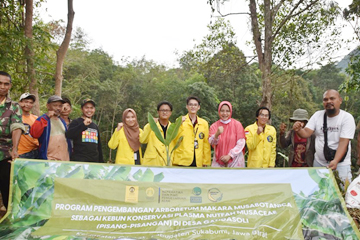
A team of academics from the Faculty of Mathematics and Natural Sciences, University of Indonesia (FMIPA UI), conducted a community service activity in Gandasoli Village, Sukabumi, West Java. The activity took place over two days, from Saturday (October 23, 2021) to Sunday (October 24, 2021).
With the theme “Development of Musabotanica Arboretum as a Medium for Germplasm Conservation”, the FMIPA UI team together with the Pandu Cendekia Foundation and DPPM UI invite the public to preserve biological biodiversity, especially plants from the banana group.
It should be noted that germplasm is a substance that carries hereditary traits and can be in the form of whole organs or parts of plants or animals, as well as microorganisms.
Germplasm is a natural resource that is invaluable for the advancement of science and technology and supports national development.
Gandasoli Village is a village with a high level of biodiversity. This village has various agricultural commodities that serve as the community’s primary source of livelihood.
Located in Cikakak District, Sukabumi, Gandasoli Village boasts fertile land and a strategic location for cultivating various plant varieties, including bananas.
This is the motivation behind the Community Service Team from the Faculty of Mathematics and Natural Sciences, University of Indonesia (FMIPA UI) to help accelerate the development of banana commodities in the village.
“The development of the Musabotanica Arboretum is a form of germplasm conservation effort to maintain and develop the best banana varieties in Indonesia. We are implementing this activity with the hope of helping improve the community’s economic sector while also becoming a nature reserve tourist area in Gandasoli Village,” said Dr. Retno to the FMIPA UI Public Relations team.
The creation of the Arboretum began with the identification and collection of various quality banana shoots. The activity continued with joint land clearing and the symbolic planting of banana shoots.
The team, consisting of six students and five representatives from the Pandu Cendekia Foundation, together with the community planted approximately 200 shoots from various varieties, such as kepok banana, raja banana, and horn banana.
The planting activity also included outreach and training for local farmers on how to create planting holes.
“A good planting hole must take into account aspects such as fertilizer composition, hole size, and spacing between plants,” said Somali, the lead instructor and banana planting outreach program. He believes this is crucial for ensuring the bananas grow well.
This program was enthusiastically received by local farmers and villagers. “We appreciate the initiative of the Faculty of Mathematics and Natural Sciences, University of Indonesia, which has contributed to the development of banana commodities in Gandasoli Village,” said Saeban, the Village Head of Gandasoli.
He hopes that through this initiative, Gandasoli Village can become a leading banana-producing region in Indonesia and a conservation area for germplasm preservation.


