


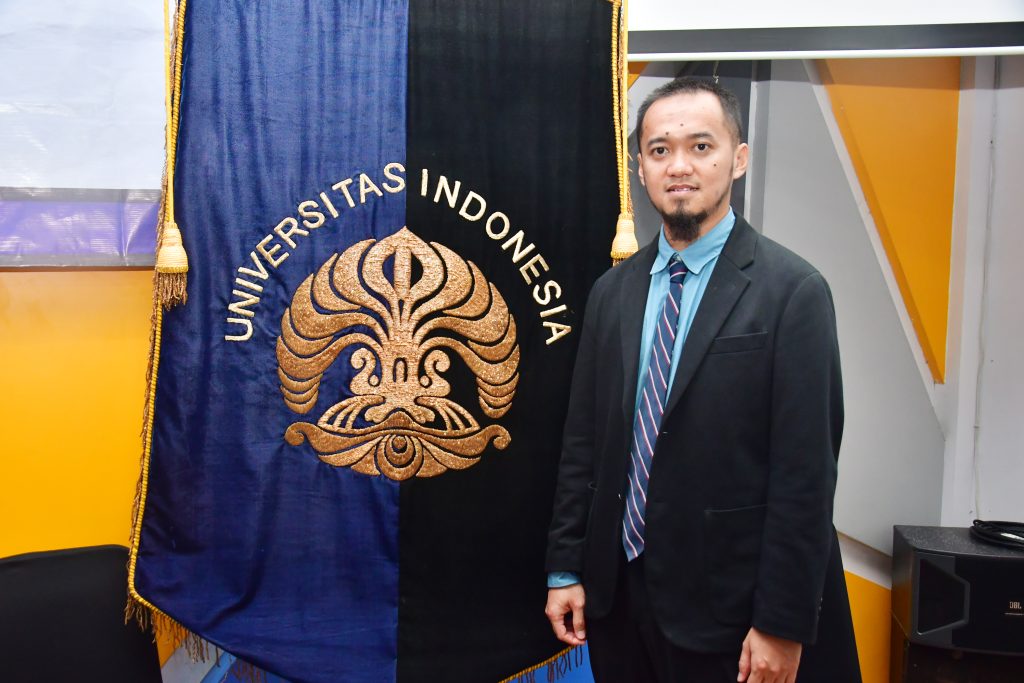
Depok, July 3, 2025 – The Faculty of Mathematics and Natural Sciences, University of Indonesia (FMIPA UI) officially inaugurated Lendriadi Agung as a Doctor of Physics in an Open Doctoral Promotion Session held at the Prof. Dr. G.A. Siwabessy Hall, UI Depok Campus. On that occasion, Lendriadi Agung successfully earned a doctorate with cum laude honors, as a form of appreciation for his academic achievements and contributions in the field of Physics.
In a session chaired by the Dean of FMIPA UI, Prof. Dede Djuhana, Ph.D., Dr. Lendriadi presented his dissertation entitled “Reservoir Fluid Dynamics Modeling for Sustainable Geothermal Development Using High Resolution Integrated Geophysical Monitoring in the Kamojang Geothermal Field.” This research was supervised by Drs. M. Syamsu Rosid, MT., Ph.D. as promoter, and Dr. Eng. Supriyanto, M.Sc. as co-promoter.

Through his research, Dr. Lendriadi presents a new approach to more efficient and sustainable geothermal energy management. He combines two high-resolution geophysical monitoring methods: time-lapse microgravity and microearthquake monitoring, to map fluid dynamics within reservoirs in three dimensions, both in terms of location and time.
The main contribution of this dissertation lies in its ability to detect changes in pressure, fluid distribution, and micro-seismic activity, which are important indicators in maintaining reservoir continuity.
Studies conducted at the Kamojang Geothermal Field found an imbalance between geothermal fluid extraction and reinjection. Only around 20–30% of the fluid was successfully returned to the ground, resulting in a significant mass deficit in the eastern region of the reservoir.
However, data for seven years (2016–2023) shows that there is a potential for natural recharge of 3.5 million tons per year, and this is even estimated to increase to 10 million tons by 2024—a huge opportunity for geothermal energy development in the region.
“This integrative approach provides a more accurate picture of reservoir conditions. This allows for more informed and sustainable management of geothermal resources,” said Dr. Lendriadi.

He further explained that this research not only offers a strategic solution for Kamojang, one of the oldest geothermal fields in Indonesia, but also serves as a scientific model that can be applied to various other geothermal areas, both at home and abroad.
He assessed that these findings are very important in determining technical strategies, such as the location for drilling new injection wells or adding make-up wells to maintain production stability.
As a country with the second-largest geothermal power generation capacity in the world, he said, Indonesia desperately needs innovations like this to ensure an energy transition to cleaner and more sustainable sources.
“I hope this method can be adopted more widely in other geothermal fields in Indonesia,” he added.


