Agriculture and plantations are two sectors that are highly dependent on weather conditions. Usually, the main planting season occurs during the rainy season when water availability is high, namely from November to March. However, climate change that occurs often causes the arrival of the rainy and dry seasons to be uncertain and difficult to predict. This significantly affects the planting season period which ultimately has an impact on national food production.
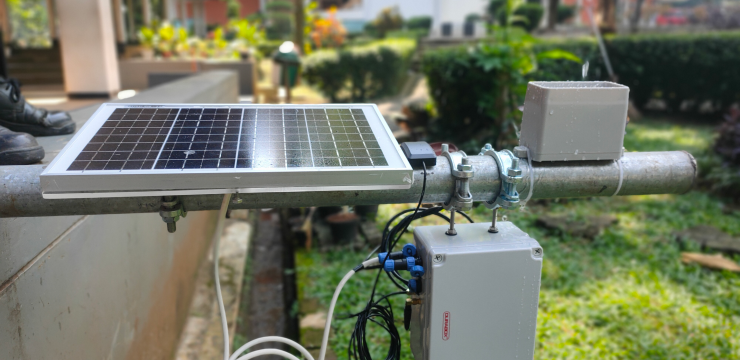
The facts in the field have led the Department of Geosciences, Faculty of Mathematics and Natural Sciences (FMIPA) of the University of Indonesia (UI) to be inspired to create an innovation called the Local Rainfall Information System (Si-Cuhal). Initiated by Dr. Eng. Supriyanto, M.Sc., Si-Cuhal is a platform that provides rainfall, temperature, and humidity data in an area collected on a cloud server. The data can be displayed in the form of daily rainfall graphs, monthly rainfall, and annual rainfall.

The Si-Cuhal platform is intended to accommodate farmers, agricultural services from local governments, the general public, and farmer cooperatives that act as suppliers of agricultural products. Supriyanto said, “The information contained in Si-Cuhal is very important in helping farmers determine the right planting season based on local weather patterns that have recently become increasingly uncertain.
Thus, it is hoped that farmer production, especially rice, can continue to be maintained.”
All rainfall graphs recorded by Si-Cuhal can be accessed anytime by farmers in a region via gadgets. Through this innovation, farmers can record, document, and analyze rainfall intensity. In addition, Si-Cuhal also provides information related to business activities in the agricultural sector.
This innovation is built on the basis of Precision Agriculture techniques. Precision Agriculture is a concept of agricultural management based on observation, measurement, and response to inter- and intra-land variability in crops. In Precision Agriculture techniques, weather is an important factor in optimizing agricultural yields. According to Supriyanto, it is time for Indonesian farmers to “upgrade” from traditional farmers to modern farmers by implementing Precision Agriculture.
The Si-Cuhal weather monitoring station has been developed since 2019 and has gone through a series of laboratory tests. In fact, the Si-Cuhal weather monitoring station technology has been applied for flood disaster mitigation purposes in the Depok, Karawang, Sumedang, and Garut areas. “Si-Cuhal initially consisted of 10 to 20 weather monitoring stations in a district or city. Si-Cuhal is able to record daily rainfall intensity, temperature, and humidity automatically every 10 minutes and send it to a cloud server for storage,” said Supriyanto.
Currently, Si-Cuhal is ready to be implemented in agricultural land throughout Indonesia as long as there is a Global System for Mobile Communication (GSM) communication infrastructure in the area. Indramayu will be the first location for the implementation of this technology. At the end of February 2024, Supriyanto and his team will depart for Mulyasari Village, Bangodua District, Indramayu, to install Si-Cuhal.
For the preparation of the installation, the team continues to coordinate with members of the Climate Change Response Farmers Association (PPTPI). After data is collected from the installed equipment, the team will conduct socialization to Indramayu farmers who are members of PPTPI.
In the future, Si-Cuhal will not only manage rainfall measurement results. This platform has been developed so that farmers can upload the types of pests that attack their agricultural land. Other farmers can then provide advice and input on how to deal with pest attacks based on their experience. Furthermore, farmers can share experiences with each other in choosing the right type of fertilizer and levels according to the characteristics of diverse agricultural land.