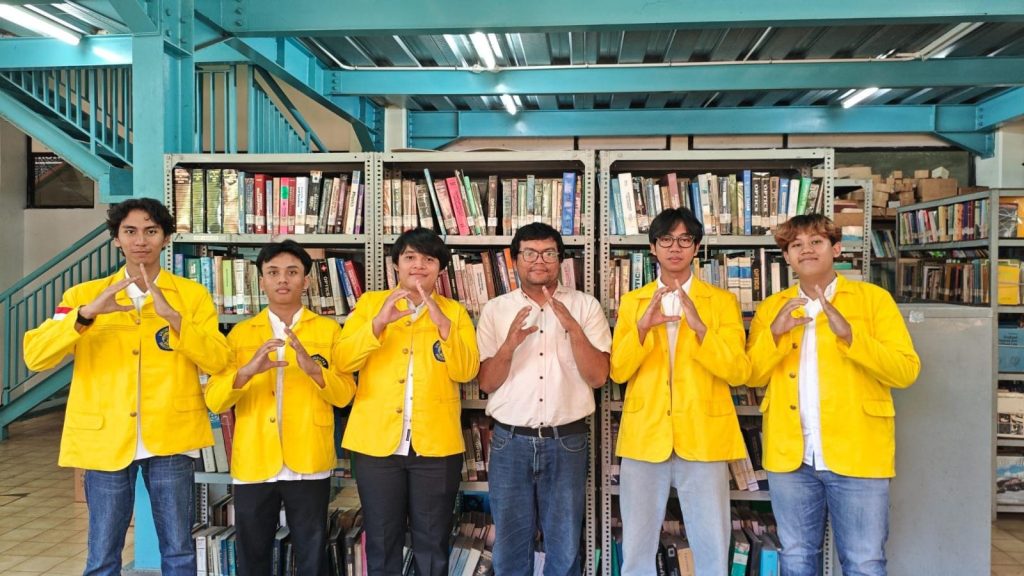
Depok, September 15, 2026 — Five undergraduate Physics students from the Faculty of Mathematics and Natural Sciences, Universitas Indonesia (FMIPA UI)—Abdurrasyid Dzaki Amir, Satria Erlangga Munggaran, Michael Gianvittorio Siringoringo, Steven Anthony Suhartoyo, and Muhammad Rayhan Pasha Nuruddin—have developed the Adaptive Energy-efficient Microclimate System (ADEM), a hybrid cooling system prototype that harnesses stable ground temperatures and solar energy. The system has the potential to reduce cooling loads by 30–50 percent, lower indoor temperatures by 4–9 degrees Celsius, and operate with less than 20 watts of power.
The idea behind ADEM emerged from the high temperatures found in learning spaces at several schools in Indonesia, as well as the significant costs associated with relying on conventional cooling systems. These conditions encouraged the team to develop a relatively affordable and easy-to-implement cooling system by utilizing a simple physical principle: the temperature difference between the ground and the surrounding environment.
“Our initial goal was to develop a cooling system that is affordable and easy to implement, particularly for spaces with limited budgets. The system utilizes the temperature difference between the ground and the surrounding environment to lower the air temperature before it enters the room,” said Abdurrasyid.
The development of ADEM was carried out through the 2026 Student Creativity Program in the Creation Initiative (PKM-KC), under the project title “ADEM: Modular Passive Cooling System Prototype Based on Subsoil Heat Exchange for Room Energy Efficiency.” The team designed a system that combines ground heat exchange, solar-powered ventilation, and an automatic control system.
Syahril Siregar, S.Si., M.Sc., Ph.D., a lecturer in the Department of Physics at FMIPA UI and the ADEM team’s supervisor, said that developing energy-efficient cooling technology is relevant to the needs of buildings in Indonesia’s tropical climate. Air-conditioning systems are among the components that require significant energy to operate buildings.
“Research like this is important because cooling systems are among the major energy consumers in buildings. ADEM demonstrates students’ ability to design practical solutions that are suited to Indonesia’s climate conditions,” said Syahril.
ADEM’s energy-saving potential is supported by the relatively stable ground temperature at certain depths. To obtain initial data, the team measured ground temperatures at the Parangtopo Laboratory, FMIPA UI, over a period of 14 days. The measurements showed that the ground temperature at a depth of 2 meters ranged from 25.5 to 26 degrees Celsius.
These data served as the basis for using the ground as a heat exchange medium. Outdoor air is circulated through a network of PVC pipes buried underground in a serpentine configuration. As the air passes through the pipes, it exchanges heat with the surrounding ground, allowing its temperature to decrease before being delivered into the room.
“ADEM utilizes the temperature difference between surface air and ground temperature. By cooling the air before it enters the room, the load on active cooling systems can be reduced,” said Abdurrasyid.
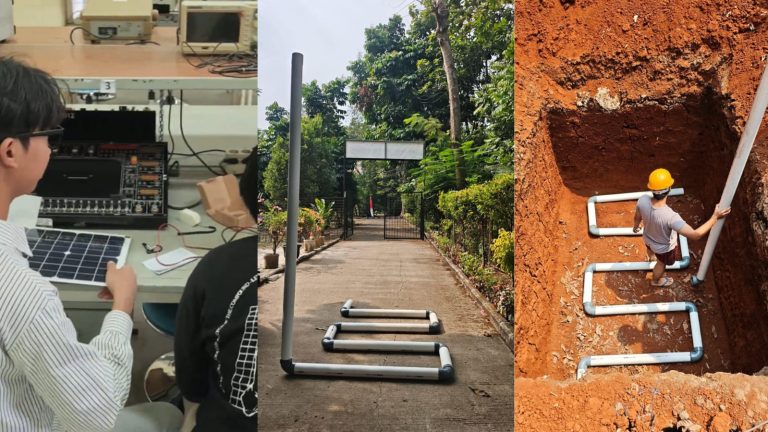
One of the challenges in developing the system was the limited space available for excavation, as well as the need to extend the air’s contact time with the pipe surface. The team addressed this by designing a serpentine pipe system with five bends and a vertically layered, multi-layer stratification configuration.
Differences in pipe diameters were also utilized to optimize airflow characteristics based on the principles of continuity and Bernoulli’s Law. The design aims to improve heat exchange efficiency without relying on high-power compressors.
ADEM is equipped with a ventilation system featuring a turbine driven by a DC motor and powered by solar panels. The system maintains air circulation, including under low-wind conditions. Temperature sensors at the inlet and outlet continuously monitor temperature changes in real time and transmit the data to an ESP32 microcontroller, which regulates the ventilator’s operation according to environmental conditions.
“We designed this system to be adaptive. When the outdoor air temperature rises, the need for air circulation also increases. Under conditions with higher solar intensity, the solar panels can generate more power to support the operation of the ventilator,” said Abdurrasyid.
Unlike conventional cooling systems that rely on refrigerant compression and require relatively high electrical power, ADEM uses ground-based heat exchange as the initial cooling stage. Solar energy supplies the ventilation system, thereby reducing reliance on electricity from conventional sources.
According to Syahril, the development of ADEM demonstrates FMIPA UI students’ ability to integrate physics concepts with technological engineering. The project combines an understanding of thermodynamics and fluid mechanics with the development of electronic systems and data-based testing.
“Students demonstrated multidisciplinary competencies by connecting physics theories, such as thermodynamics and fluid mechanics, with applied electronic systems engineering. Another strength lies in their ability to validate the concept computationally and conduct empirical field testing,” said Syahril.
The implementation of the 2026 PKM-KC program has currently reached approximately 90 percent completion, with 89.82 percent of the allocated budget utilized. The team has also disseminated the development results through social media and mass media. On September 15, 2026, the team participated in the national stage of the program online.
The official announcement of the teams advancing to the 2026 National Student Scientific Week (PIMNAS) has not yet been released. The ADEM team hopes to advance to the next stage, taking into consideration the achievement of the program’s outputs, the completeness of its documentation, and the testing data collected.
Following the completion of the PKM-KC program, ADEM’s development will continue in the Department of Physics at FMIPA UI, utilizing the facilities of the Parangtopo Laboratory and Electronics Laboratory. The next stages will include performance testing in an enclosed space (enclosure testing), optimization of the control algorithm, and plans to file a patent application. The team is also preparing scenarios for implementing ADEM in various types of buildings, including residential buildings, educational facilities, places of worship, community spaces, and green buildings. This development is aimed at evaluating the application of ground-temperature- and solar-energy-based cooling technology as an alternative approach to reducing the energy requirements of building cooling systems.