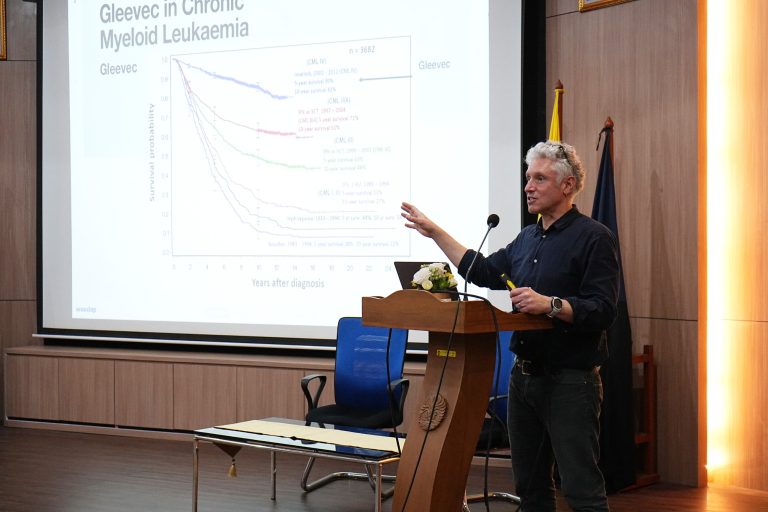
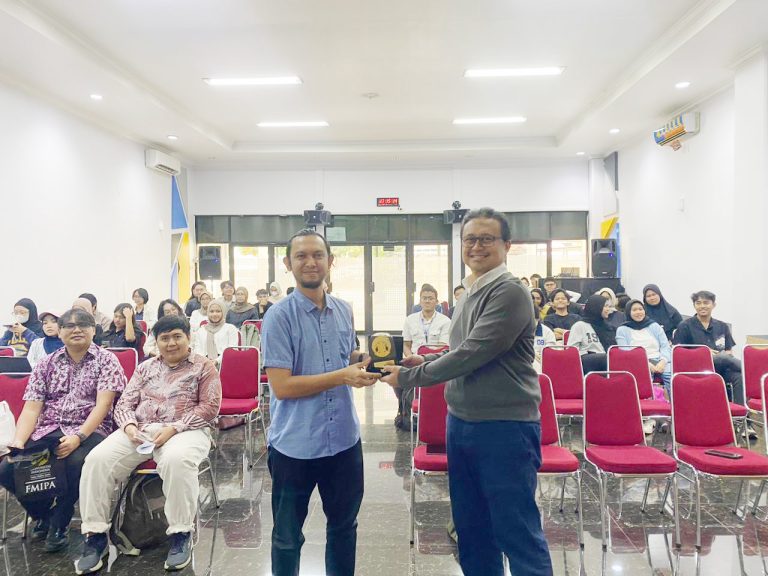
Professor Dale L. Bailey, a nuclear medicine physicist from the University of Sydney and Head of the Department of Nuclear Medicine from Royal North Shore Hospital, Sydney, attended the Annual Scientific Meeting of Medical Physics and Biophysics Indonesia organized by the Faculty of Mathematics and Natural Sciences (FMIPA) UI at the Santika Hotel Depok, Saturday (12/8/2017).
In this forum, Prof. Bailey outlined the advancements and applications of nuclear medicine technology, which is widely used, particularly in cancer treatment, in Australia. His presentation was attended by approximately 200 medical physicists and nuclear medicine practitioners from various universities and hospitals in Indonesia.
Prof. Bailey explained that he has collaborated with and provided extensive training in nuclear medicine in Indonesia for a long time. He expressed his admiration for the extraordinary developments in the use of nuclear medicine in Indonesia over the past three decades.
“I came and became involved in nuclear medicine in Indonesia in 1998. I remember the first place I visited, the facility was still fully funded, and the electricity went out every afternoon,” he recalled.
“The expensive, donated equipment was unused because no one knew how to operate it, and it eventually broke down. It was tragic,” added Prof. Bailey. But that situation has changed significantly.
“There’s a better system in place now. Several PET/CT scanners are available in Jakarta and Bandung. Several centers also offer this service. While the existing equipment still uses third-world technology, they are highly skilled at using it. That’s a huge help,” he added.
According to Professor Bailey, Indonesia’s developments can still be expanded. However, he acknowledged that funding and infrastructure remain key challenges hindering the sector’s development in developing countries.
This situation, he said, is understandable, as the technology used in nuclear medicine requires expensive equipment. Indonesia, however, faces numerous other health issues that may require prioritization.
However, he praised and appreciated the enthusiasm of nuclear medicine practitioners in Indonesia in addressing these limitations by focusing more attention on nuclear medicine studies, such as dosimetry, which is the method of determining the dose of radiopharmaceuticals to be injected into a patient’s body to suit their individual needs.
“This is something that’s very possible. They can develop expertise in this area because dosimetry doesn’t require a lot of resources or expensive machinery. It just requires a piece of paper and radioactive calculations. And I think Indonesia currently has a much stronger knowledge base in this area than other developing countries,” said Professor Bailey.
Nuclear medicine is a medical technique that involves the use of radioactive fluids injected into a patient’s body. These fluids emit radiation that can reveal abnormalities within the body, from blood clots in the lungs or tumors to abnormal, active cells in cancer.
The advantage of this technology, according to Prof Bailey, is its ability to carry out targeted treatment only on active cancer cells so that treatment can be more effective.
PET/CT scanning is a method in nuclear medicine to detect the presence of active cells in the body by giving the patient a radioactive tracer (FDG) and then scanning it with a Gamma Camera machine.
And today nuclear medicine technology has become a commonly used tool in cancer treatment in Australia along with other treatment methods such as chemotherapy, radiotherapy and immunotherapy.
One measure of the progress of the use of nuclear medicine technology in Australia is that with a population of around 25 million people, Australia currently has around 70 to 75 main machines in nuclear medicine, namely Positron Emisson Tomography (PET) Scanner machines.
This advantage is what makes Australia the main reference country for medical physicists and medical practitioners in Indonesia who want to increase their capacity.
As stated by Dr. Supriyanto Ardjo Prawiro, from the Department of Physics, FMIPA UI, who is also the chairman of the Indonesian Medical Physicists Alliance.
“Australia is very advanced in its use of nuclear medicine technology. We have established many collaborations, particularly in clinical training, where we are currently using the Australian system. Many staff at the Faculty of Mathematics and Natural Sciences, University of Indonesia, have also been sent to study in Australia,” he explained.
Supriyanto hopes that this collaboration can be expanded in the future, especially in the areas of scientific research and training of medical physics staff.