The Multidisciplinary Community Service Team (pengmas) of the University of Indonesia (UI) held a series of virtual workshops on beekeeping, organic and inorganic waste processing, as well as marketing management and service quality. The pengmas team consists of three lecturers from the Faculty of Mathematics and Natural Sciences (FMIPA UI), namely Dr. Astari Dwiranti, Dr. Ratna Yuniati, Afiatry Putrika, M.Si, three lecturers from the Faculty of Engineering (FTUI), namely Dr. M. Sahlan, Dr. Kenny Lischer, Dr. Apriliana Cahya K, and Prof. Amy Yayuk S and Nidaan K, M.Sos from the Faculty of Administrative Sciences (FIA UI). In carrying out this activity, the team was accompanied by assistants and eight students from across faculties, in collaboration with practitioners from the 3bee community (Jeffry Lesmana, Yogi Hutomo) and the Holistika Institute.
Workshop participants came from various backgrounds, ranging from academics, forestry service employees, agricultural service employees, to practitioners and the general public from various regions in Indonesia, including participants from Sumatra, Java, Sulawesi, the Nusa Tenggara Islands, Kalimantan, and Papua. Dr. Astari Dwiranti, as the head of the UI multidisciplinary community service team, explained that this community service program was implemented to educate the community and in the future is expected to support a sustainable household economy, especially during the current pandemic conditions.
“Despite the pandemic, this community service activity continues to benefit the community. We are grateful that this online workshop has been able to attract a wide range of community members. The material presented is very comprehensive, providing participants with a comprehensive understanding of the technical aspects of beekeeping and waste management,” said Astari.
Dr. M. Sahlan, a lecturer at the Faculty of Engineering, University of Indonesia, said, “During this pandemic, various activities are being carried out at home, and new hobbies are also emerging, such as cycling, gardening, and others. In this activity, we are offering the concept of urban bees, utilizing stingless bees that are suitable for urban areas. We hope that Indonesians, even though many are at home, can still be productive.”
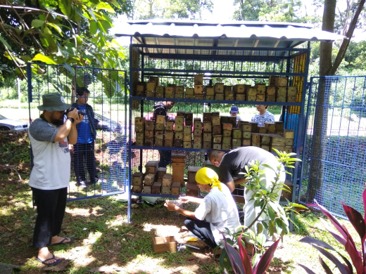
The workshop series was divided into eight sessions. The first through fifth sessions covered beekeeping and its products, including honey, pollen, fermented pollen, royal jelly, venom, beeswax, propolis, and more. In the waste processing session, participants learned how to process organic waste to produce fertilizer, eco-enzymes, local microorganisms, animal feed, and more. Similarly, inorganic waste can be processed into various useful products, such as various creations and even paving blocks.
The workshop series, held from October 10, 2020 to November 7, 2020, concluded with the topic of marketing and service quality. Prof. Amy Yayuk, Professor of the Faculty of Administrative Sciences, University of Indonesia, explained that any business sector is inevitably linked to marketing and service quality (servqual). “In the COVID-19 pandemic era, both marketing and servqual have undergone changes in their implementation and have adapted to communication technologies such as digital marketing and e-servqual. Bee and waste product businesses can no longer be marketed face-to-face to customers but digitally, utilizing social media such as WhatsApp, Instagram, Facebook, and so on,” said Prof. Amy.
“We hope this series of workshops will raise public awareness about utilizing local resources through sustainable beekeeping and waste management. Going forward, this community service program can serve as a model that can be replicated elsewhere, in keeping with its theme: bees and waste bring blessings,” said Astari.