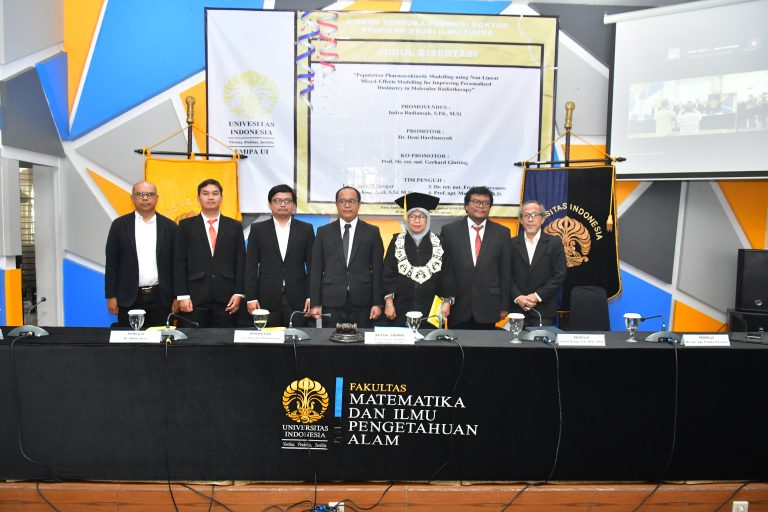
Depok, June 9, 2026 — The Faculty of Mathematics and Natural Sciences, Universitas Indonesia (FMIPA UI), has once again graduated a new doctoral scholar from its Physics Study Program. Indra Budiansah earned his doctoral degree with a perfect Grade Point Average (GPA) of 4.00 and the distinction of summa cum laude after completing his studies in six semesters.
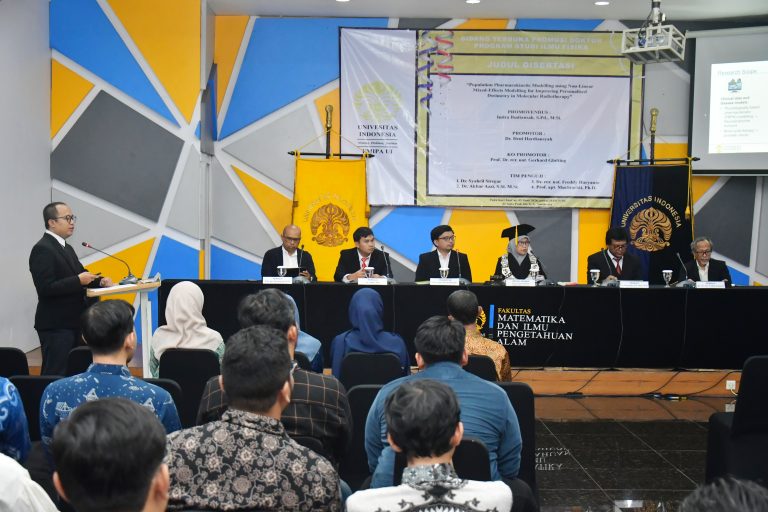
The degree was conferred during a doctoral defense held at the Prof. Dr. G. A. Siwabessy Hall, FMIPA UI, Depok, on Friday (June 5). The session was chaired by Prof. Dr. Ivandini Tribidasari Anggraningrum, S.Si., M.Si., Vice Dean for Resources, Ventures, and General Administration of FMIPA UI.
Indra defended a dissertation entitled “Population Pharmacokinetic Modelling Using Non-Linear Mixed-Effects Modelling for Improving Personalised Dosimetry in Molecular Radiotherapy.” The research was supervised by Dr. sc. hum. Deni Hardiansyah from FMIPA UI and Prof. Dr. rer. nat. Gerhard Glatting from the Department of Nuclear Medicine (Nuklearmedizin), Universitätsklinikum Ulm, Germany.
The involvement of a supervisor from an international partner institution reflects FMIPA UI’s research collaboration with the global academic community in advancing innovation in the fields of medical physics and radionuclide-based cancer therapy. This collaboration highlights FMIPA UI’s commitment to fostering international research partnerships and contributing to the development of cutting-edge healthcare technologies.
Indra’s research focused on the development of a population pharmacokinetic (PopPK) model based on non-linear mixed-effects modelling (NLME) to improve the accuracy and precision of personalized dosimetry in molecular radiotherapy (MRT). This approach is expected to support the implementation of more targeted cancer treatments tailored to the biological characteristics of individual patients.
Cancer remains one of the world’s greatest global health challenges. According to GLOBOCAN 2022 data, there are approximately 20 million new cancer cases and 9.7 million cancer-related deaths worldwide each year. This figure is projected to rise to 35 million cases by 2050. Among the various types of cancer, prostate cancer and neuroendocrine tumors are among those associated with a significant disease burden.
In this context, molecular radiotherapy (MRT) has emerged as a promising treatment modality, particularly for patients with advanced and metastatic cancers. However, the success of the therapy largely depends on the ability to determine the appropriate radiation dose for each patient through personalized dosimetry.
“Currently, personalized dosimetry generally requires a series of repeated imaging sessions over several days following therapy. This procedure can be burdensome for both patients and healthcare facilities. Through this research, we aim to develop a method that remains accurate while being far more practical,” said Indra.
The research comprised two main studies. First, it evaluated single-time-point (STP) dosimetry using a physiologically based pharmacokinetic (PBPK) model in eight patients undergoing therapy with the radiopharmaceutical [90Y]Y-DOTA-TATE. Second, it assessed STP dosimetry in multi-cycle [177Lu]Lu-PSMA-617 therapy involving ten prostate cancer patients, taking into account inter-occasion variability (IOV), or variations occurring between treatment cycles.
All model development, parameter estimation, and computational simulations were carried out using NONMEM version 7.6.1 software.
The research findings showed that the optimal parameter configuration for the PBPK model was achieved by incorporating receptor density, internalization rate, and degradation rate parameters. In addition, the integration of inter-occasion variability (IOV) in multi-cycle therapy was proven to reduce the number of outliers in dosimetry estimates while increasing flexibility in determining the timing of a single imaging session.
“Our findings demonstrate that PopPK modelling using the NLME approach can serve as a robust framework for generating accurate personalized dosimetry from just a single imaging session. This opens up opportunities for broader implementation in routine clinical practice without compromising the quality of radiation dose estimation,” said Indra.
According to him, the approach has the potential to improve patient access to personalized dosimetry services while simultaneously reducing the operational burden on hospitals.
The research promoter, Dr. Sc. Hum. Deni Hardiansyah, assessed that the dissertation makes an important contribution to the development of medical physics and nuclear medicine, particularly in supporting more precise cancer therapy.
“This research not only addresses methodological challenges that have long limited single-time-point dosimetry, but also demonstrates how population modelling approaches and multi-cycle therapy data can improve the reliability of dose estimation for patients. It represents an important step forward toward the implementation of more efficient, evidence-based personalized dosimetry,” said Dr. Deni.
Through this research, Indra successfully addressed three key questions that had not previously been studied extensively in a systematic manner: the optimal parameterization of PBPK models, the accuracy and precision of PBPK-NLME–based single-time-point (STP) dosimetry, and the impact of integrating inter-occasion variability on dose estimation in multi-cycle therapy.
These findings are expected to support the future implementation of personalized dosimetry that is more practical, accurate, and efficient in radiopharmaceutical-based cancer therapy. In addition to strengthening FMIPA UI’s contribution to advancing research in medical physics and computational health technologies, this study also has the potential to serve as an important scientific foundation for the development of more precise, affordable, and sustainable nuclear medicine services in Indonesia.