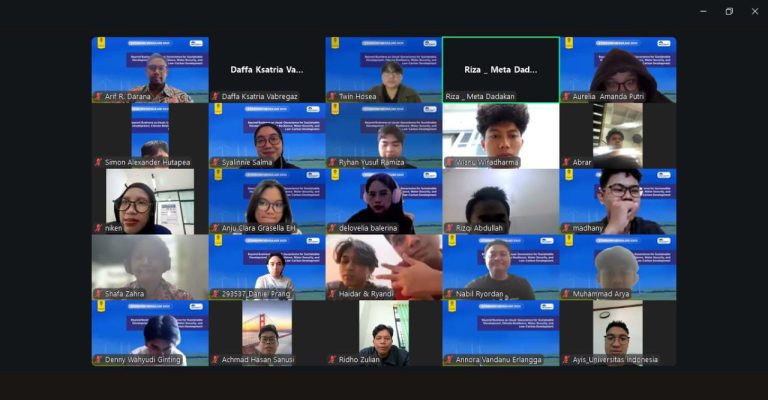
To broaden students’ insights on environmental issues and sustainable development challenges, the Faculty of Mathematics and Natural Sciences at Universitas Indonesia (FMIPA UI), through the Geosciences Study Program, held the UI Geosciences Seminar X Starborn Teaching with the theme “Beyond Business as Usual: Geoscience for Sustainable Development, Climate Resilience, Water Security, and Low-Carbon Development.” The event, held online on Monday, 24 November 2025, was attended by 80 students from the Geology and Geophysics Study Programs.
Arif Rahmansyah Darana, M.Sc., Head of the Environment, Social, and Governance (ESG) & Geotechnics Department at Vanguard Energy Group Indonesia, attended as the speaker. In his presentation, Arif emphasized the important role of geoscience in addressing increasingly complex environmental issues.
“Climate crises, land subsidence, and even water scarcity are no longer future issues. These are real challenges that must be addressed with a comprehensive understanding of Earth’s systems,” he said.
Arif then added that geoscience-based approaches can drive the development of more resilient solutions for sustainable development.
“Geology, hydrology, and human–environment interactions are the foundations for designing adaptive and low-carbon policies. Without these, we lack a strong scientific basis,” he explained.
He also introduced various applications of geoscience in disaster mitigation, aquifer management, spatial planning, and the development of sustainable energy such as geothermal power and carbon storage. In addition, Arif highlighted the transformation of the geoscientist’s role in the modern era.
“Geoscientists today no longer work solely in extractive sectors. We are involved in ESG, water resilience, and even geospatial analysis. The spectrum of these roles is becoming increasingly broad and strategic,” he said.
The question-and-answer session proceeded dynamically, with students asking about various career opportunities and the skills needed in the fields of sustainability and climate-change mitigation.
The event concluded with a documentation session between the speaker and all participants, marking the end of the seminar series.