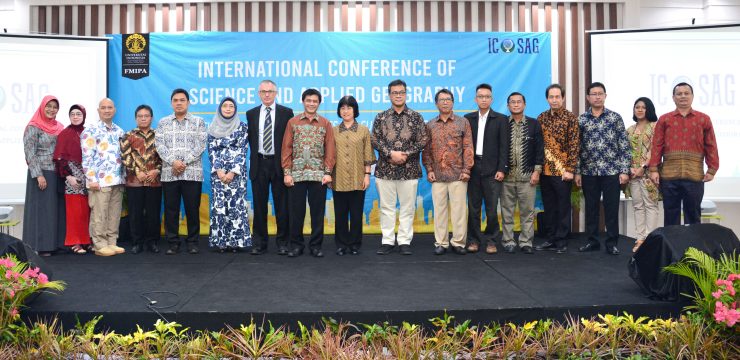
“The Department of Geography, Faculty of Mathematics and Natural Sciences, University of Indonesia (FMIPA UI) held an International Conference in the field of Applied Science and Geography entitled the International Conference of Science and Applied Geography (ICoSAG) on Saturday (24/8) at the Sinarmas Hall, Multidisciplinary Research Laboratory Building, FMIPA UI – PT. Pertamina, UI Depok Campus.
“Bringing the big theme “Improving the Quality of Human Resources and the Environment for Sustainable Development” the Conference accommodates studies in the field of geography and the application of science.
Not only attended by researchers from Indonesia, this activity was also attended by researchers from Japan, Malaysia, and England.
This conference brought four main themes to be discussed, namely the application of spatial models, applied geography, human geography and regional development, and geography education.
Spatial modeling applications focus on disaster risk reduction and spatial planning modeling for agriculture, farming, coastal areas and remote islands.
Meanwhile, applied geography focuses on hydrology and water resources, meteorology and climatology, and dynamic landscapes. “Climate change influences changes in river patterns,” said Trevor Hoey of the University of Glasgow.
Droughts and erratic rainfall patterns reduce the water holding capacity of rivers, lakes, and streams, resulting in slightly polluted water. Higher temperatures can reduce oxygen levels, killing fish and significantly damaging ecosystems.
According to Trevor, historical river patterns can help researchers observe changes in river shape over time. Thanks to increasingly sophisticated technological systems, research is becoming easier to conduct for sustainable living.
However, he also hopes that in the future there will be a solution for a faster research process so that mitigation efforts can be carried out early.
Meanwhile, human geography and regional development focus on the development of social capital, empowerment of cultural identities and communities, economic and social transformation and regional development.
Then, geography education discusses the study of geography. “Landscape is always a problem, just like poverty and land issues,” said Jatna Supritna, Head of the Research Center for Climate Change, University of Indonesia.
According to him, there must be a balance between production and long-term protection to maintain the stability of natural biodiversity, so that there is prosperity in the agricultural sector for humans and other living creatures in the forest.
Animals and plants play a significant role in forest regeneration. Without animals, the forest will lack the carbon dioxide needed for photosynthesis. If plants cannot photosynthesize, they will die, further reducing the oxygen supply.
Scientific studies are essential in the process of developing research that can be used as a planning system and utilization of the earth’s geographical features.
The dynamics of the use of natural resources and human resources tend to ignore the capabilities of the ecosystem, which can have an impact on reducing the carrying capacity, resilience and sustainability of development.