Depok, September 22, 2025 — The Faculty of Mathematics and Natural Sciences (FMIPA) at Universitas Indonesia, through the Department of Geosciences, held the fifth week of the Universitas Indonesia Geoscience Seminar (UIGS) X STARBORN MENGAJAR 2025, themed “Prospect Maturation: Advancing Lead to Drillable Prospect.” The seminar discussed key strategies in the exploration and production of oil and gas (O&G) and took place at the Prof. Dr. G.A. Siwabessy Hall, FMIPA UI, Depok Campus.
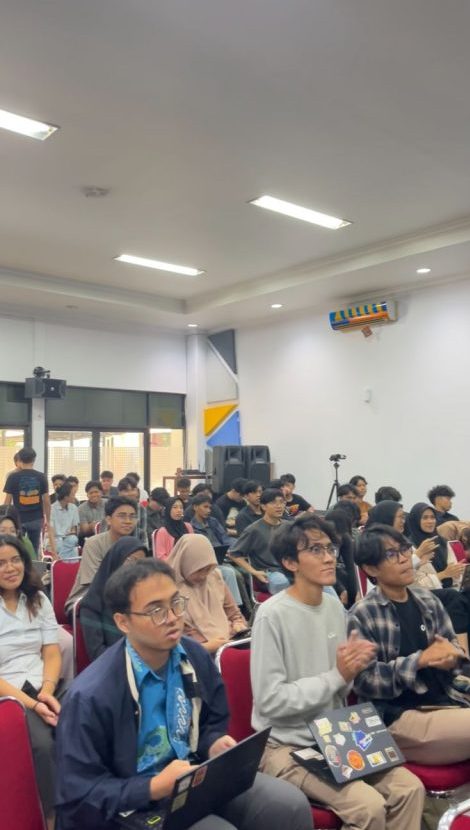
The event was attended by approximately 80 students from the Geology and Geophysics Study Programs at FMIPA UI. In the seminar, participants received a comprehensive presentation on the prospect maturation process—that is, the systematic transformation from a lead (an initial indication of hydrocarbon trap potential) into a drillable prospect ready for technical and economic evaluation.
As the main speaker, Achmad Andi, M.T., an Exploration Geophysicist from Saka Indonesia Pangkah Limited, presented on the importance of a multidisciplinary approach in hydrocarbon exploration. He explained that prospect maturation is an integral process encompassing geological and geophysical evaluation, engineering design, and economic feasibility analysis.
“Prospect maturation is not just about discovering oil and gas reserves. It is a process of risk management and investment decision-making based on thorough scientific and economic analysis,” said Achmad. “Each stage is designed to reduce uncertainty and increase the likelihood of exploration success.”
In his presentation, Achmad also outlined the main stages of prospect maturation, starting from initial lead identification, resource volume estimation, geological risk evaluation (Probability of Geological Success / PoSg), to the calculation of economic values such as Expected Monetary Value (EMV) and Mean Expected Financial Success (MEFS). All this data serves as the basis for final investment decision-making, or Final Investment Decision (FID).
Additionally, participants were introduced to the five key elements of a petroleum system—namely source rock, reservoir rock, seal rock, migration processes, and trap—which must coexist spatially and temporally to enable hydrocarbon accumulation.
The seminar became more interactive through a case study session presented using the Mentimeter platform. In this session, participants analyzed 2D seismic sections to identify potential leads, assess their viability as prospects, and directly discuss various exploration risk factors.
To conclude, the committee held an interactive quiz session via Kahoot! aimed at testing participants’ understanding while creating a relaxed atmosphere amid the discussion of complex material. Participants’ enthusiasm was evident from their active engagement throughout the event.
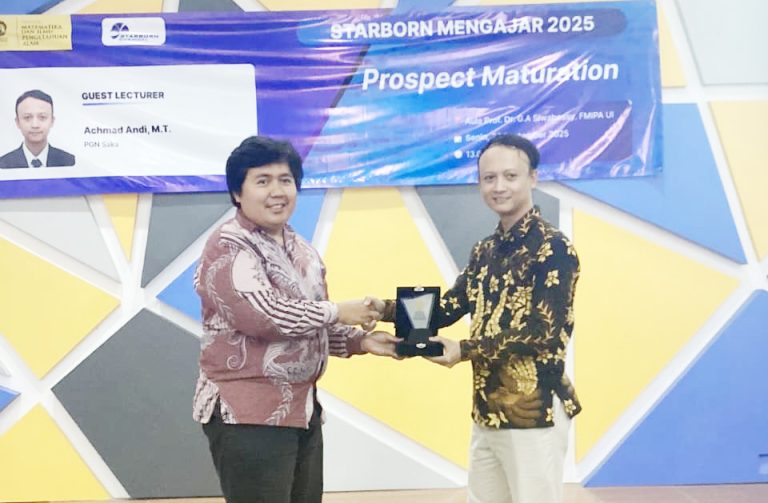
The event concluded with the presentation of a commemorative plaque to the speaker and a group photo session with all participants. UIGS X STARBORN MENGAJAR 2025 represents FMIPA UI’s, particularly the Department of Geosciences’, tangible commitment to supporting the development of earth sciences and fostering a culture of scientific discussion among students and young professionals in the geosciences field.