The ranking organization Quacquarelli Symonds has once again released the Quacquarelli Symonds World University Ranking (QS WUR) by Subject. This year, through its official website /www.topuniversities.com/subject-rankings/2023, QS WUR placed UI at the top among universities in the country for both Broad Subjects and Narrow Subjects categories.
In the QS release, UI scored the highest in three out of five Broad Subject categories. From these Broad Subjects, two recorded rankings for four Narrow Subjects or fields of study originating from the Faculty of Mathematics and Natural Sciences (FMIPA) UI.
The Broad Subject categories referred to are Natural Sciences and Life Sciences & Medicine.
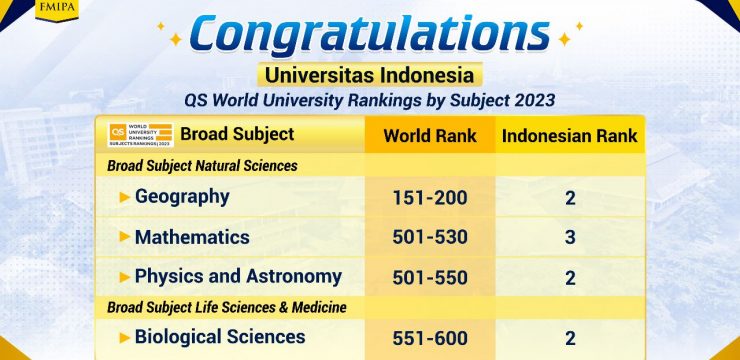
In the Broad Subject category of Natural Sciences, the fields of Geography, Mathematics, and Physics & Astronomy are included as Narrow Subjects. Geography has maintained its position over the past four years, ranking between 151 and 200. Physics & Astronomy also held the same rank as last year, placing between 501 and 550.
This year, the field of Mathematics has extended the list of fields in the Broad Subject category of Natural Sciences with a ranking of 501–530.
Meanwhile, the field of Biological Sciences in the Broad Subject category of Life Sciences & Medicine remains steady at the ranking of 551–600.
The Rector of UI, Prof. Ari Kuncoro S.E., M.A., Ph.D., said in his release on March 23, 2023, “This achievement, which places UI as the best in Indonesia according to the QS WUR by Subject 2023 release, motivates UI to continue improving in the future. Thank you for all the contributions made by the UI academic community. Together, we are moving toward the goal of becoming the best and most respected university in ASEAN.”
He hopes that UI will be the best in all subject areas.
The Dean of FMIPA UI, Dede Djuhana, Ph.D., expressed his gratitude for this achievement. In agreement with the rector, he also conveyed his appreciation and thanks to the FMIPA UI academic community for their efforts and contributions in enhancing the faculty’s academic reputation both nationally and internationally.
Moreover, the Dean said, enhancing academic reputation is the vision and mission of FMIPA UI that must be realized together.
“Alhamdulillah, we are very grateful because improving academic reputation is our vision and mission at FMIPA UI. With the increasing number of fields of study at FMIPA UI recorded in the rankings, we are certainly optimistic that this success will be followed by other fields in the future,” said Dean Dede to the FMIPA UI public relations team.
Nevertheless, he emphasized to the faculty members and academic community to remain enthusiastic in increasing research publications and to increase participation in international academic activities.
“Building collaborations with partners both domestically and internationally to produce creative innovations is also important and must continue to be pursued,” he added.
In this QS ranking, five aspects are evaluated: Academic Reputation, Employer Reputation, Citations per Paper, H-Index, and International Research Network (IRN). Academic Reputation is derived from collecting votes from over 151,000 academics worldwide between 2018 and 2022. Each respondent provided their opinion about universities in their respective fields of expertise.
In addition, Employer Reputation is also needed to assess employability metrics based on the reputation of employers. More than 99,000 votes from global employers were taken into account between 2018 and 2022 to provide extensive information related to recruitment.
In addition to assessments from academics and employers, Citations per Paper is also one of the evaluation indicators used to measure the average number of citations received per publication, estimating the impact and quality of scholarly work produced by universities. In this ranking, the QS team analyzed over 16.4 million papers published between 2016 and 2020, resulting in nearly 117.8 million citations from 2016 to 2021.
The H-Index is also used to measure the consistency of the impact and quality of works published by the institution’s scientists and scholars, while the International Research Network (IRN) measures efficiency in building stable research collaborations across the five Broad Subject Areas. A total of 1,594 institutions ranked 54 Narrow Subjects within the five Broad Subject Areas, producing more than 18,300 ranking entries.
Post Views: 222