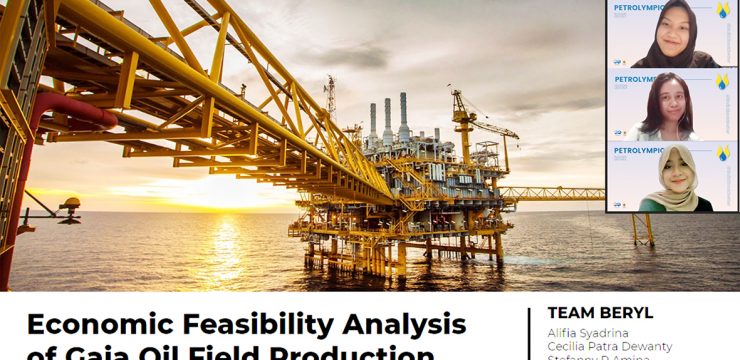
The 2019 Geoscience student team from the Faculty of Mathematics and Natural Sciences, UI, consisting of Stefanny Rizika Amina, Cecilia Patra Dewanty, and Alifia Syadrina, successfully brought FMIPA UI to the international stage by winning 2nd place in the PETROLYMPICS SPE UI SC 2021 Case Study Competition with the theme “Reinforcing the Post-Covid-19 Era of Oil and Gas Industry for Future Sustainability”. This was announced at the event awarding day via the Zoom Meeting platform on October 2, 2021.
Of the 3 branches of competition offered, namely case study, paper and smart competitionThe team, named BERYL, chose the case study competition category, where participants were challenged to create the best solution to a case according to the rules and guidelines set by the committee.
“The case study involved a scenario involving an oil field seeking to improve production efficiency economically. Each team was given approximately 24 days to discuss and develop a solution, which was then structured into a presentation format. During the presentation, we were given 15 minutes to present our solution, followed by a 15-minute question-and-answer session with the judges,” said Stefanny, team leader.
Furthermore, Stefanny said that the innovation brought by his team focused on producing an oil field development plan that could be implemented from an economic perspective.
“Our team came up with three solutions for the given case study: improving maintenance efficiency, which reduced maintenance costs by 25%; negotiating platform costs by up to 70%; and implementing mob-demob during the installation process, which reduced installation costs by 5-10%. Implementing these three solutions is ideal in a scenario where crude oil prices drop by $2 per year, and can also generate an IRR of up to 33.77%,” he said.
In completing the case study, the BERYL Team reported that they didn’t encounter any significant difficulties in dividing up the work. They also divided tasks based on each team member’s strengths.
“For the overall process of working on this competition, we work together, but I myself am more focused on the completion process which involves calculations through Excel“Furthermore, since this is our first time participating in a competition that concerns the economic aspects of oil production, we also need the help of a mentor, a relative of mine who is already involved in the oil and gas sector, to exchange ideas,” said Cecil, explaining the form of collaboration he and his team have established.
The BERYL team also shared the challenges they faced during the competition. One of them was that the PETROLYMPICS competition is under the Faculty of Engineering, so the approach to solving the problems and the judges’ expectations regarding the solutions they developed were very different. Despite this, Stefanny and her team members still saw this as motivation to broaden their horizons and learn new skills.
Despite the challenges they faced, they were very grateful for the many benefits they gained from various aspects, as expressed by one of the team members, Alifia.
“Some of the benefits we get include gaining experience as a participant in a competition in a field that suits our interests and expertise, such as the opportunity to exchange ideas, express opinions, and work together in a team. Through this competition, we also learn to hone our skills. problem-solving and critical thinking which will be very useful in the future,” explained Alifia.
Closing the interview, the BERYL Team advised other FMIPA UI students to always see opportunities as opportunities for growth and not to be afraid of the risks involved in competitions. Online lectures can also be a source of encouragement, indirectly leveraging them to explore their knowledge more deeply.
which will be very useful in the future,” explained Alifia.Reinforcing the Post-Covid-19 Era of Oil and Gas Industry for Future Sustainability”.
The competition starts on September 6, 2021. The competition mechanism is by sending files in the form of case studies which must be completed and presented to all judges by October 1, 2021. The winners will be announced on awarding day via the Zoom Meeting platform on October 2, 2021.