The efforts to revitalize the transmigration area under the support of the Indonesian Ministry of Transmigration have entered an important phase. The Patriot Expedition Team from the Faculty of Mathematics and Natural Sciences at Universitas Indonesia (FMIPA UI), in collaboration with a team from the Faculty of Medicine UI (FK UI), has completed an intensive four-month research project in the Belantikan Raya Transmigration Area, Lamandau Regency. The team—comprising lecturers, students, and alumni—applied a multidisciplinary approach, covering environmental and social aspects as well as public health.
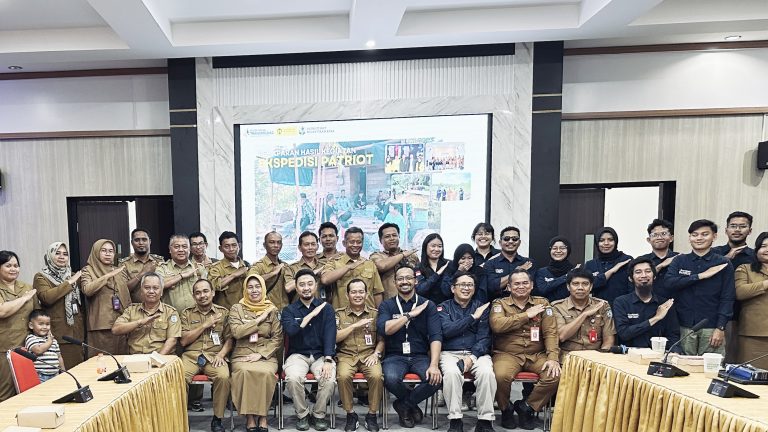
The culmination of the program took place on December 1, 2025 with a Focus Group Discussion (FGD) to disseminate field findings at the Lamandau Regency Secretariat Hall. The event was attended by local government officials, academics, industry actors, and representatives of transmigrant communities. The FGD presented two key outputs: an Evaluation of the Transmigration Area and a Development Design for Leading Commodities across six Settlement Area Units (SKP). The recommendations highlighted the urgency of improving production structures, strengthening the branding of local leading commodities, and reinforcing value chains. (value chain) komoditas di Kawasan Transmigrasi Belantikan Raya.
The Assistant for Economic Development and Natural Resources Administration of Lamandau Regency, Dr. Meigo, S.Pd., M.Si., who opened the event, emphasized the importance of data-driven research as a foundation for policy-making.
“We need input, data validation, and constructive recommendations. Good data must be translated into good policies that generate real impact for the community,” said Dr. Meigo while delivering the Regent’s remarks.
The UI team reported that pest attacks continue to affect farmers’ coffee plants, resulting in an average productivity of only 0.3–0.4 tons per hectare—far below the optimal potential of robusta, which can reach up to 0.8 tons per hectare. In addition to coffee, the team also identified rice, durian, and watermelon as potential diversification commodities.
The Lead of Output 2, Iqbal Putut Ash Shidiq, M.Sc., Ph.D., emphasized that the recommendations are iterative and remain open to input from the local government.
“We want to ensure that these recommendations are truly applicable, not merely ending up as documents, and can be immediately implemented by both the government and the community,” said Iqbal.
Output Team Member 2, Nur Auliya Musrah, M.Si, added that many local commodity potentials need to be further developed to strengthen the community’s economy.
“In the field, the team found a local rice commodity in SKP C that has high demand, including during the Lamandau Expo series of events. The rice is grown naturally without the use of fertilizers or pesticides and has distinctive qualities, such as a fragrant aroma and small-sized grains.”
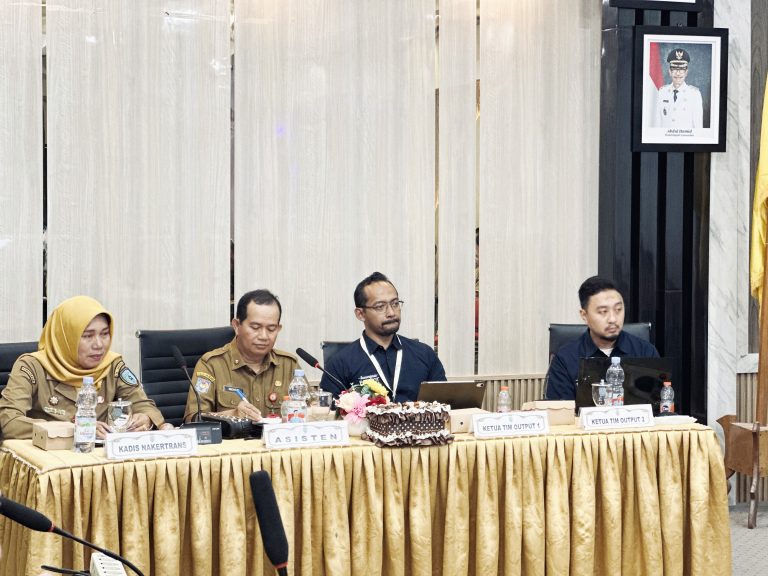
The Head of the Lamandau Manpower and Transmigration Office, Atie Dieni, S.Sos., M.A.P., affirmed that the regional government has designated robusta coffee as a priority commodity.
“Coffee must remain a sustainable commodity and our top priority. We are receiving state budget (APBN) support for the procurement of superior seedlings, along with commitments from major industry offtakers,” she emphasized.
There is currently a national offtaker ready to absorb the production as long as the quality and volume meet the standards, creating opportunities for farmers to increase their income by 30–40%.
The Lead of Output 1, Dr. Med. dr. Nyityasmono Tri Nugroho, Sp.B, Subsp. BVE (K), expressed hope that this study would bring a “new perspective” to the transformation toward a more productive modern transmigration system.
In addition to the government and academia, representatives of the farmers also conveyed their needs.
“I hope there will be assistance from production to marketing, as well as support for fertilizers,” said Purwanto, a coffee farmer in SKP A.
The main concerns raised by farmers include the difficulty of accessing plantation roads, which remain inadequate; the limited number of field extension officers who can provide regular guidance; and the fluctuating selling price of coffee due to the lengthy supply chain. On the other hand, the UI Team highlighted several technical barriers that must be addressed promptly to ensure the recommendations can be implemented effectively, ranging from damaged roads that slow down logistics, the absence of post-harvest centers such as solar dryers for coffee processing, to the lack of quality standards or grading systems. Without improvements to basic infrastructure, the potential of leading commodities is considered unlikely to reach an economically viable scale.
The development of Lamandau’s coffee aligns with the national strategy of the Ministry of Transmigration and the agenda to promote value-added commodities as engines of regional economic growth. The national coffee consumption trend, which continues to rise by 7–8% annually, presents significant opportunities for transmigrant communities to emerge as new producers.
In addition, the development of coffee aligns with the green economy agenda through agroforestry, which helps preserve the forest cover of Belantikan Raya—one of the key ecological landscapes in Central Kalimantan.
The entire series of activities reflects the strong commitment of the Regional Government and academic institutions in designing a research-based future for the transmigration area. However, the local government notes the need for sustained attention from the central government, particularly in accelerating the development of production and logistics roads, strengthening regular human resource training, and supporting downstream processing so that farmers are not limited to selling raw beans. With such multilayered support, the seven SKPs in Lamandau are expected to achieve commodity-based economic independence within the next three to five years.
The teams involved in this program were divided into two groups. Output Team 2, which focused on the Design for the Development of Specific Leading Commodities, was led by Iqbal Putut Ash Shidiq, M.Sc., Ph.D., with members Nur Auliya Musrah, S.Pd., M.Si., Intan Lestari, S.Si., Muhammad Annas Fathoni, and Ahmad Faiz Marzuqy. Meanwhile, Output Team 1, which handled the Recommendations for the Evaluation of the Transmigration Area, was led by Dr. Med. dr. Nyityasmono Tri Nugroho, Sp.B, Subsp. BVE (K) from the UI Faculty of Medicine, with members Dr. Trevino Aristarkus Pakasi, FS, MS, Sp.KKLP, Ph.D., Amelia Insan Pratiwi, S.Si., Genta Aulia Ramadhan, MT., Muhammad Rafi’ Putra Agustian, and Elfis Metkono.