The phenomenon of climate change has impacted ecosystems and humans across all continents and oceans worldwide. Climate change can pose significant risks to human health, global food security, and economic development. One of the greatest impacts of climate change is on the oceans. Rising sea levels will impact coastal communities and low-lying areas worldwide, causing flooding, coastal erosion and submergence, and the loss of small islands.
On Saturday (20/11), the Department of Geography, University of Indonesia, in collaboration with WWF Indonesia and Greenpeace Southeast Asia, held a mini webinar entitled “Climate Crisis 1.0: Damaged Oceans, Affected World.”
The mini webinar is part of a series Geographic National Society Summit (GNSS), The 13th Geography DaysThe webinar was held online through the Zoom Meeting platform. The 13th Geography Days committee also invited experts in their respective fields, including Imam Musthofa, Head of the WWF Indonesia Marine and Fisheries Program, and Arifsyah Nasution, Greenpeace Southeast Asia Marine Campaigner.
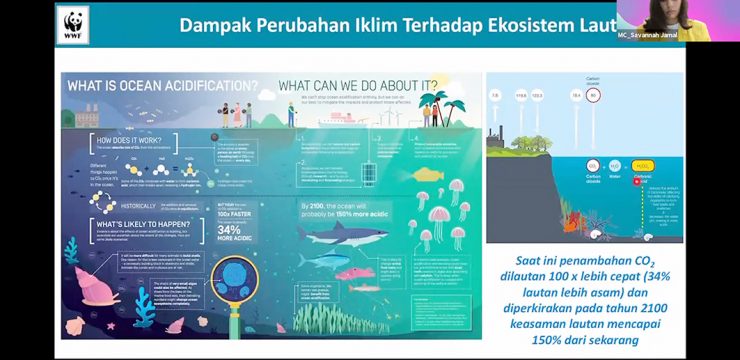
The webinar begins with an opening by the moderator and ice breakingThe presentation began with Imam Musthofa, the first speaker. In his presentation, he explained the latest developments on climate change in Indonesia as it relates to marine issues, the impact of the climate crisis on marine ecosystems, and the importance of protecting the oceans.
“Since 1900, the Earth’s temperature has risen by almost 4 degrees. This figure is worrying many people,” explained Mr. Imam.
“Heat from the impact global warming The biggest impact is on the sea, with absorption reaching 93%. So you can imagine kan “What kind of impact does it have on the marine ecosystem?” he added.
Followed by the second speaker, Arifsyah Nasution, who explained how sea level rise can occur, the dangers that occur when sea levels rise, and the steps that the community can take to prevent this.
Following the presentation by the speakers, a question-and-answer session, moderated by Savannah Jamal, lasted approximately 40 minutes. At the end of the webinar, both speakers also provided closing statement-nya.
“The young generation, including my student friends, is influencer most important in tackling the climate crisis. Do it and take action.said Mr. Imam
“It’s important for all levels of society to develop critical thinking skills, such as through discussions and studies, and to enhance academic morality. Future leaders need to learn a lot from the mistakes of current leaders. No matter how small a contribution, if carried out by many, it will have a positive impact,” added Mr. Arifsyah.
The National Geographic Society Summit (GNSS) is part of the 13th Geography Days series. The event will be held online and will include two mini-webinars on the theme “Climate Crisis 1.0: Oceans Damaged, World Affected” and “Climate Crisis 2.0: Start Managing to Prevent Disasters” as well as the main webinar with the themeCollaborative Efforts and Innovation for Climate Crisis“. GNSS was attended by experts in their respective fields from various government and private institutions as a form of collaboration in addressing the climate crisis.