The need for technological innovation is inextricably linked to the availability of energy, especially electricity. Energy is a national necessity that will continue to increase, both in terms of demand and basic needs, but its availability is inversely proportional to population growth.
Indonesia is projected to be unable to survive if it relies solely on fossil fuels, which it has relied on to date. Therefore, alternative energy sources are needed to meet the national electricity demand and sustain disaat yang bersamaan. Nuklir, menjadi salah satu alternatif sumber energi yang memiliki potensi mengatasi kebutuhan tersebut.
However, nuclear power still has traumatic effects on society and has led to strong resistance. Previous nuclear incidents in other countries have become a factor in the public (and government)’s assessment of Indonesia’s readiness to develop this core energy source.
Despite over 60 years of experience managing the use of nuclear technology and research reactors, efforts to convince the public, policymakers, and stakeholders need to be ongoing and optimized. One way to do this is by continually introducing and disseminating information to ensure public understanding. urgensi dan manfaat-resiko dari teknologi nuklir.
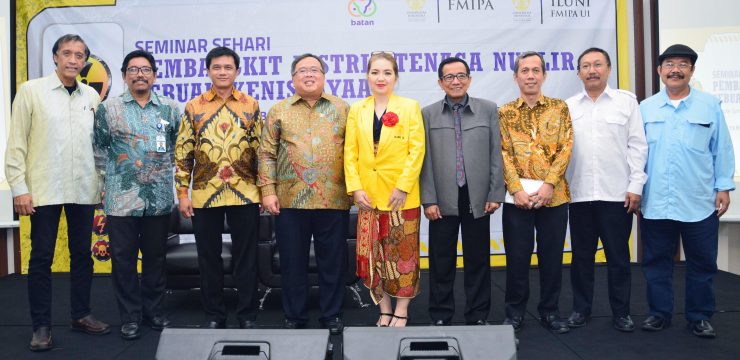
With this background, FMIPA UI and ALUNI FMIPA UI in collaboration with BATAN held a one-day seminar with the theme “PEMBANGKIT LISTRIK TENAGA NUKLIR, SEBUAH KENISCAYAAN”, on Wednesday (11/13/2019) in the Sinarmas Hall of the Multidisciplinary Research Laboratory Building, FMIPA UI, UI Campus, Depok, with the presence of the Minister of Research and Technology (Menristek)/Head of the National Research and Innovation Agency (BRIN) Prof. Bambang PS Brodjonegoro, and the head of the National Nuclear Energy Agency (BATAN) Anhar Riza Antariksawan as Keynote Speaker.
Dean of the Faculty of Mathematics and Natural Sciences, University of Indonesia (FMIPA UI), Prof. Dr. rer. nat. Abdul Haris, officially opened the event. In his remarks, he stated that as an academic institution, FMIPA UI plays a role in research and community service. Therefore, the academic community feels the need to participate in overseeing technological development, including nuclear technology.
Echoing Prof. Haris, Pamela Cardinale, Chair of the Alumni Association of the Faculty of Mathematics and Natural Sciences (ILUNI FMIPA UI), explained that mastery of science and technology is one of the keys to the success of sustainable national development. Technology is also increasingly entrenched in people’s daily lives, and the need for technological innovation is inextricably linked to the availability of energy, especially electricity.
Energy is a national necessity that will continue to increase, both in terms of demand and basic needs, but its availability is inversely proportional to population growth. Indonesia is projected to be unable to survive if it relies solely on the fossil fuels it has relied on to date. Alternative energy sources are needed to meet the national electricity demand and sustain di saat yang bersamaan. Nuklir, menjadi salah satu alternatif sumber energi yang memiliki potensi mengatasi kebutuhan tersebut.
“There have been numerous studies from academic institutions like those at UI that have been submitted as input to the government, but why has a nuclear power plant never materialized? That’s why the UI Faculty of Mathematics and Natural Sciences Alumni Association (Alumni FMIPA UI) wants to play a role in encouraging the government to immediately realize a nuclear power plant, one way of doing this is through this One-Day Seminar,” Pamela added.
Minister of Research and Technology Bambang said that Indonesia has the capability to manage nuclear energy for the benefit of national development and public welfare, including in developing electrical energy through the use of nuclear technology. “Believe that the Indonesian nation already has the capability to manage nuclear energy for the benefit of the public,” said Bambang after giving his presentation.
According to him, socialization and dissemination of nuclear utilization and nuclear safety must be carried out to all Indonesian people so as to provide insight to those who do not yet understand that nuclear power plants are safe and can produce electricity for national needs.
“It needs to be explained that the world is different now, nuclear technology is being used everywhere and incidents are now very small and can be…handle (handled), the most important thing is our ability to maintain and care for it,” he said.
Furthermore, he said that after mastering nuclear technology, one must also master aspects of nuclear power plant maintenance and safety by utilizing higher levels of domestic components.
Research and Technology Minister Bambang encouraged the National Nuclear Energy Agency to continuously update its technological advances by adopting the latest technologies. Indonesia can also learn from nuclear power plant developers abroad to strengthen its preparedness in the event of a nuclear power plant being urgently needed.
Meanwhile, the Head of BATAN, Anhar Riza Antariksawan, said that his party is ready and continues to strive to disseminate information regarding security and safety in the use of nuclear technology to the public, especially the general public and those who are anti-nuclear.
Anhar also said that BATAN was only given the task of being a research and development agency, where its application or utilization was limited to non-commercial matters, and even if it was commercial, it was only in the form of services and had to cooperate with third parties.
“In fact, when it comes to discussing nuclear power plants (NPP) or nuclear energy in various forums and even debates, the issues raised are still almost the same as 30 years ago. However, one thing that makes me happy is that nowadays the discussion on NPP is not only coming from BATAN, but also from many other parties. This is because the matter of NPP or nuclear energy is not solely BATAN’s responsibility, but a concern for all of us, and therefore we should all think about it together,” said Anhar.