To date, waste remains a major problem in large cities, including Jakarta. This problem is caused by many factors, such as low public awareness of the importance of maintaining a clean environment and limited knowledge about waste management methods.
People, especially children, do not yet understand the importance of sorting and managing waste as an effort to reduce the increasing volume of waste.
This prompted lecturers and students from the Biology Department Student Association (HMD), a member of the FMIPA UI Community Service Team, to conduct an educational program on waste management for children. The team believes that waste education is crucial to instill from an early age.
This program, chaired by Yohana Shanny, received funding support from the Directorate of Student Affairs, University of Indonesia and the Pandu Cendekia Foundation.
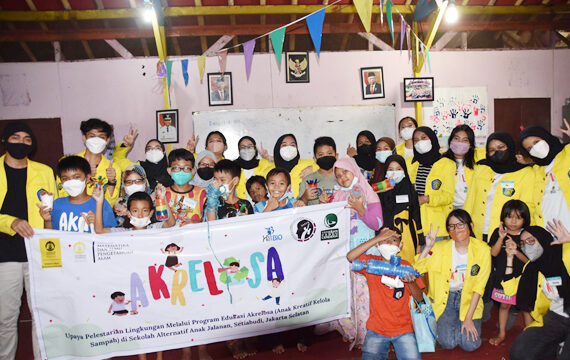
Under the guidance of Afiatry Putrika, M.Si., a lecturer at the Department of Biology, FMIPA UI, the Team, in collaboration with the Gesit Waste Bank, has conducted waste management education for students at the Alternative School for Street Children (SAAJA) through an activity themed “Creative Children Manage Waste” or abbreviated as “Akrelosa”.
The event took place over two days, from Wednesday, November 17, 2021, to Thursday, November 18, 2021, at SAAJA, Kuningan, South Jakarta.
By implementing strict health protocols, the team invited 15 students from grades 3 to 5 SAAJA to learn more about the types of waste, the impacts that arise if waste is not managed properly, and how to manage waste simply.
On the first day, the team began by providing participants with educational materials on waste sorting and management. They also explained the impact of waste on other living things, such as organisms in rivers and oceans.
Marine waters polluted by waste have a negative impact on the stability of the marine ecosystem and the living creatures within it.
For example, marine pollution caused by microplastics resulting from the degradation of plastic waste can enter fish. If humans consume fish containing these microplastics, they can cause poisoning.
The activity continued with educational games that tested the children’s knowledge of the types of waste and their impacts, as previously explained. The first day’s activities concluded with a discussion on managing used plastic waste to stimulate the children’s creative ideas for transforming used plastic into useful items.
Arkan Askarillah, as the chairman of the Biology Department Student Association, said that because the activity was carried out in a way that involved playing while learning, all the children appeared enthusiastic in the activity.
The following day, the team and participants visited the Gesit Waste Bank, located in Menteng Pulo, Setia Budi District, South Jakarta. The children enthusiastically listened to the explanation of the management system at the Gesit Waste Bank.
They line up to weigh the trash they’ve brought from home to deposit at a waste bank. The collected waste is sorted and then delivered to a craft facility or a waste collection point. For their trash collection, the children receive a reward as a token of appreciation.
Afiatry Putrika, the supervising lecturer, stated that this activity is expected to give SAAJA students a different perspective on waste. She added that, as the next generation, school-age children need to be taught the importance of sustainable environmental management, one way of doing this is through the AKRELOSA program.
“We hope that what our senior students teach can be applied by the students, at least in their school and home environments,” said Afiatry.
This activity was responded positively by the administrators and teachers at SAAJA School. SAAJA Principal Kristina Iin Dwiyanti welcomed the FMIPA UI community service team’s program.
“I think the event organized by UI students is good because it can broaden children’s knowledge about waste,” said Kristina Iin Dwiyanti.
He hopes that through the Akrelosa program, children will be equipped to manage waste and contribute to their families’ finances. Furthermore, he hopes to increase students’ awareness of waste and the environment, making them more aware of their surroundings.
This activity will also hone the creativity of SAAJA students, and will instill the understanding that waste is not something that is just to be thrown away, but can be turned into something useful.