Indonesia is an archipelagic nation with significant potential for economically valuable coral reef fisheries. One of the most widely exported reef fish is grouper. Indonesia contributes 36% to global grouper production. Grouper is a key capture fishery commodity on Madura Island.
Grouper fishing on Madura Island occurs almost year-round, from August to March, with a peak season occurring from April to July. The potential annual grouper resource in Madura Island waters reaches 159.8 tons, with an optimal fishing effort of 1,179,166 round-trip voyages.
However, the high level of exploitation in coral fish catch by fishermen, especially in spawning areas (spawning) and the increasingly widespread damage to coral reefs as a habitat for coral fish will certainly cause coral fish stocks, including grouper, to decrease and possibly disappear from the waters.
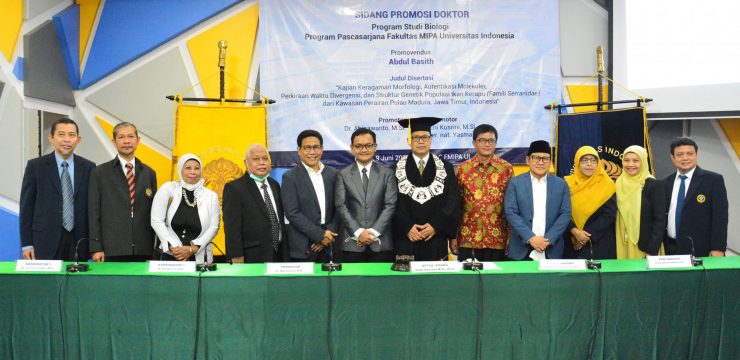
These facts were conveyed by Dr. Abdul Basith in the doctoral promotion hearing of the Biology Study Program, Faculty of Mathematics and Natural Sciences, University of Indonesia (FMIPA UI) which was held in an open face-to-face manner on Thursday (9/6/2022) in the Hall of Building C, UI Campus, Depok.
“The fact that there is an increase in the exploitation of grouper fish species as the main commodity on Madura Island is the basis for research on the morphological and genetic diversity of grouper fish (family Serranidae) in the waters of Madura Island, which is urgently needed as a basis for information for determining their conservation status and management in the future,” said Dr. Abdul Basith, explaining the background of his research.
In the summary of his dissertation entitled Study of Morphological Diversity, Molecular Authentication, Estimated Divergence Time, and Genetic Structure of Grouper Population (Serranidae Family) from Madura Island Waters, East Java, Indonesia He describes his research on morphological and molecular approaches to grouper species inventory, while also analyzing the microevolutionary patterns of sunu grouper (Plectropomus maculatus).
““Basic information is essential to support the management and utilization of grouper fish on Madura Island, particularly to maintain genetic resources, species, and the grouper ecosystem. Basic research on grouper fish in Madura Island waters begins with species identification and inventory based on a morphological approach,” he said.
However, he said, the morphological character approach to grouper species identification is not without its drawbacks, potentially leading to errors in identification. These errors are caused by confusion or ambiguity in the similarities in color patterns and body shapes between grouper species. However, accurate grouper species identification is crucial as a foundation for conservation management and subsequent related research, so a molecular approach is needed to complement the morphological approach.
Based on this research, he found that 100 percent of grouper fish in Madura Island waters were successfully identified to the genus level and 83.9 percent were identified to the species level using a morphological approach. Furthermore, 67.7 percent of grouper specimens were identified using partial CO1 gene sequences, but 10 specimens, or 32.2 percent, were not identified. The integrated use of these two approaches successfully resulted in an inventory of 13 grouper species in Madura Island waters.
Several novel values in this study are also described. Among them are information in the form of documentation and analysis of the results of species identification and morphological diversity of grouper fish found in the waters of Madura Island to complete the inventory of grouper fish species in Indonesia and their distribution, then new information in the form of partial DNA barcode data of accurate CO1 gene sequences for the identification of grouper fish species found in the waters of Madura Island, including the results of phylogenetic tree reconstruction, genetic diversity, as well as for inclusion in the GenBank (NCBI) and BOLD system databases.
There is also a very interesting novelty value, namely for the first time in Indonesia, especially in the field of Evolutionary Biology, an analysis of the estimated genetic divergence time of grouper fish using the RelTime method and its comparative efforts with the Bayesian method by utilizing partial molecular data of the CO1 gene sequence. The final results of this analysis are combined with a Geographic Information System (GIS) approach to map the distribution pattern of the sunu grouper fish so as to illustrate the journey of genetic evolution of the sunu grouper fish.
The results of this study are expected to be important supporting data to complete information on the genetic resources of local grouper fish on Madura Island as germplasm, as well as for the development of marine resource conservation strategies, especially fish genetic conservation. This is in line with the Government Regulation of the Republic of Indonesia Number 60 of 2007 concerning the Conservation of Fish Resources and the Decree of the Minister of Maritime Affairs and Fisheries Number 79/KEPMEN-KP/2016 concerning the Fisheries Management Plan for the Fisheries Management Area of the Republic of Indonesia 712 (WPPNRI 712).
For his achievements, the Administrator of the Mamba’ul Ma’arif Denanyar Jombang Islamic Boarding School Foundation received a Doctorate with a Very Satisfying predicate under the guidance of Dr. Drs. Abinawanto, M.Si. as promoter, and Dr. Eni Kusrini, M.Si., and Dr.rer.nat. Yasman, S.Si, M.Sc. as Co-Promoters.
The meeting, chaired by the Dean of FMIPA UI, Dede Djuhana, Ph.D., was also attended by Drs. H. Abdul Muhaimin Iskandar, M.Si. (Deputy Chairman of the House of Representatives of the Republic of Indonesia), Dr. (HC) Drs. A. Halim Iskandar, M.Pd. (Minister of Villages, Development of Disadvantaged Regions and Transmigration of the Republic of Indonesia), and Prof. Dr. rer. nat. Abdul Haris (Deputy Chancellor for Academic and Student Affairs, University of Indonesia).