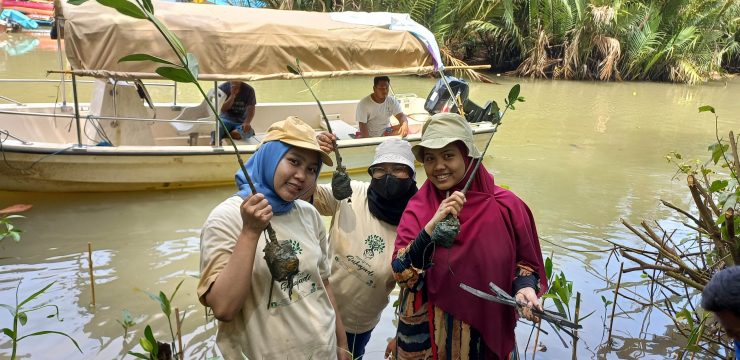

Monday (15/8/2022), the Faculty of Mathematics and Natural Sciences, University of Indonesia (FMIPA UI) through the Sukajadi Mangrove Team implemented one of the 318 community service (pengmas) programs launched by the Directorate of Community Service and Empowerment (DPPM).
This community service program was implemented through outreach activities and the planting of 500 mangrove seedlings at Lagundi Beach, Sukajadi Village, Pandeglang, Banten, as an effort to minimize the impact of abrasion due to the Sunda Strait tsunami that occurred in 2018.
The activity entitled “Mangrove Tourism Development Program to Address Abrasion Problems in Sukajadi Village, Pandeglang, Banten” is one of the manifestations of the Tri Dharma of Higher Education, namely the responsibility of higher education elements to the community and the fulfillment of Sustainable Development Goals (SDGs).

Team leader Drs. Wisnu Wardhana, M.Si., said, “Mangrove planting needs to continue, not only to prevent abrasion, but also as a habitat for other organisms, carbon fixation, and the beginning of tourism development that will improve the local economy.”
He believes Sukajadi Village has the potential to become a model village for other regions through mangrove cultivation that is suited to its geographical conditions. Mangrove planting, while paying attention to spacing between mangroves, Drs. Wisnu said, also has a unique appeal for both local and international tourists to visit and learn about the mangrove ecosystem.
“We hope that Sukajadi Village will gradually become a model village for other regions by cultivating mangroves that are suited to its geographical conditions and by adjusting the planting distances accordingly, thereby attracting local and foreign tourists to visit and learn about the mangrove ecosystem,” he said.
In this activity, the team involved lecturers from the Department of Biology, FMIPA UI, namely Dr. Retno Lestari, S.Si., M.Si., as well as the Conservation Community Movement Group (KOMPAK).
In line with the vision and mission conveyed by the team leader, the community hopes that the mangrove planting will be sustainable. “The mangrove planting activity is right on target in preventing abrasion and potential disasters. The community wants to continue contributing and hopes that this program can run sustainably to control, rejuvenate, and increase the diversity of plants in the Sukajadi Village mangrove ecosystem,” said KOMPAK chairman Saiful Bahri.