


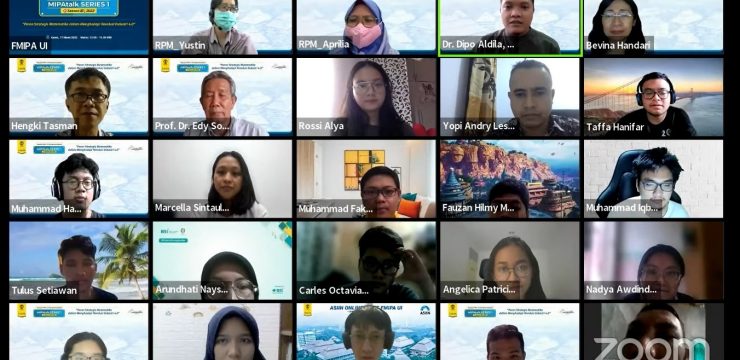
Thursday (17/3/2022). The Faculty of Mathematics and Natural Sciences, University of Indonesia (FMIPA UI) held a webinar series through an online seminar program entitled MIPAtalk. This webinar is the first series of the MIPAtalk program which is now entering the second series. In this first series, Mipatalk raised the theme “The Strategic Role of Mathematics in Facing the Industrial Revolution 4.0”.
The first MIPAtalk series was also broadcast live through the FMIPA UI Official YouTube channel. Webinar participants are open to the public and consist of academics within UI and outside UI.
Present as speakers were Professor of the Industrial and Financial Mathematics Expertise Group, FMIPA ITB Prof. Edy Soewono, Ph.D, with Dr. Hengki Tasman from the Department of Mathematics, FMIPA UI as moderator.
The event was opened by Dede Djuhana, Ph.D. as Dean of FMIPA UI. In his speech, he said that the first MIPAtalk series was held as a form of collaboration between FMIPA UI and FMIPA ITB as well as a discussion space to update each other on research developments and the latest knowledge in the field of science.
The event was opened by Dede Djuhana, Ph.D. as Dean of FMIPA UI. In his speech, he said that the first MIPAtalk series was held as a form of collaboration between FMIPA UI and FMIPA ITB as well as a discussion space to update each other on research developments and the latest knowledge in the field of science. programming or mathematics, we don’t have to master it but at least understand the gist of it so that we can adapt in today’s era. I hope FMIPA UI can make a big contribution in this field,” said the Dean of FMIPA UI.
Prof. Edy Soewono in his presentation brought five main points related to the strategic role of mathematics in the era of the industrial revolution 4.0. Among them are challenges and opportunities, the Independent Learning Independent Campus (MBKM) program, the role of mathematics and mathematicians, industrial activities at the Multi-Disciplinary Research Center (P2MS)-ITB, and future hopes.
“Taken from several references, the important thing is to introspect the materials we need, generally oriented towards problems. big dataThere are mining data analysis, mathematical programming, research, artificial intelligence, machine learning, and so on. The question is, can all of them be taught in a mathematics study program? Some might say yes. However, is it enough to just put it in the syllabus? Where is the role of the lecturer?” explained Prof. Edy explaining the big problems that often arise among mathematicians.
In addition, Merdeka Belajar Kampus Merdeka (MBKM) as a program of the Ministry of Education and Culture in the last two years has become an activity that is expected to be held on every campus with various forms of activities, ranging from student exchanges, internships, teaching in schools, involvement in research, building villages, independent studies or projects. Student entrepreneurship to humanitarian projects. But unfortunately, said Prof. Edy, the field of mathematics has not been widely included in the MBKM programs.
“It can be identified that in the field of mathematics, the eight activities mentioned above are very minimal compared to other fields,” he said.
Still in his presentation material, Prof. Edy encouraged lecturers to provide lecture materials that are closely relevant to the real world. And for that, there needs to be support from facilities or an environment that accommodates as a gateway to the industrial world.
Prof. Edy Soewono closed his presentation by explaining the challenges and responsibilities of the mathematics community to prepare graduates for the industrial era 4.0.
“We need to accommodate development soft skill as part of academic activities with credits. It is not easy to do it alone. However, if we utilize the competencies that exist out there, we can gradually build them in the mathematics study program. However, the curriculum is a problem because its form is very dense with mandatory supporting lectures causing opportunities to build soft skill to be very minimal.”
In addition, the involvement of lecturers in Industrial Networking also needs to be optimized, one of which is through international collaboration activities and lecturer-student interactions in multidisciplinary sciences. This is also what is applied on the ITB campus so that P2MS ITB was born.
No less important, continued Prof. Edy, is the deployment of young champion lecturers who are ready to adapt to new demands and grow the confidence of mathematics lecturers to interact with partners and disciplines outside of mathematics.


