In line with President Joko Widodo’s idea of “Indonesia as the World’s Maritime Axis”, the Center for Marine Studies, Faculty of Mathematics and Natural Sciences, University of Indonesia, which is also the Regional Maritime Partner Consortium (KMB) of DKI Jakarta, and as part of the Indonesian Maritime Partner Association (AMBIN) together with the Coordinating Ministry for Maritime Affairs of the Republic of Indonesia, is carrying out an activity with the theme “Maritime Insight Introduction Program for Indonesian Children (PPWK-AI)” as support for President Jokowi’s idea.
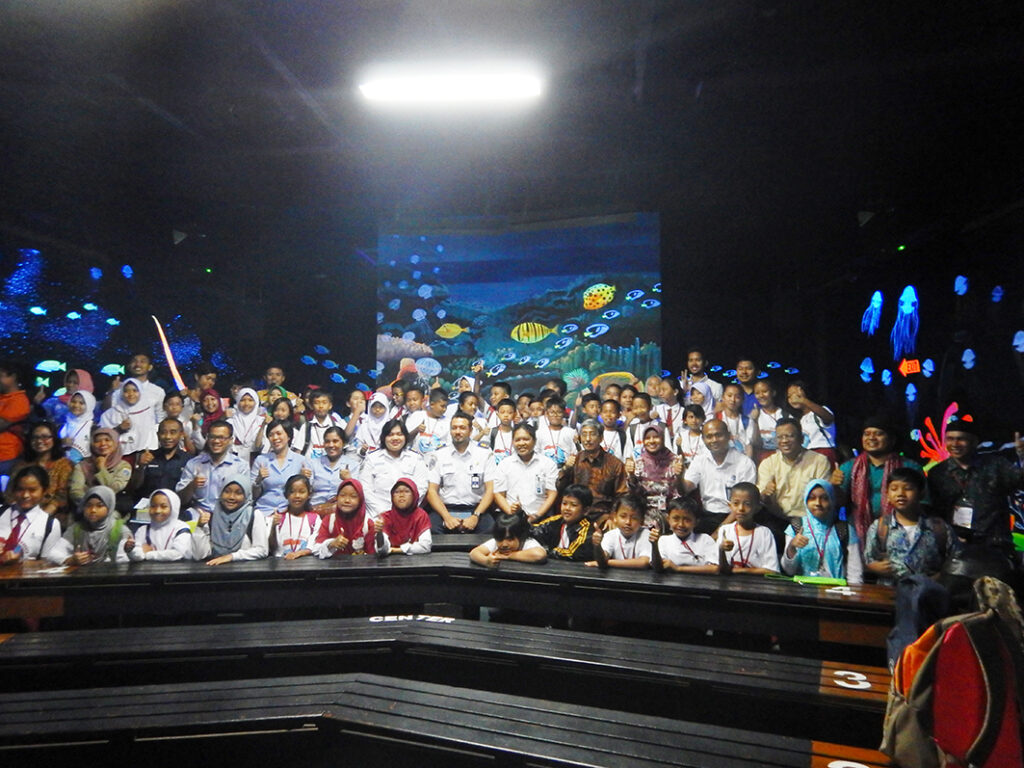
The activity, which was held on 22-23 August 2016 in the Sea World Ancol area and Tidung Kecil Island, Seribu Islands, invited 50 participants, students from the best elementary schools in Jakarta.
In this activity, participants are given an understanding of why maritime insight must be known from an early age, and an introduction to several marine biota that are commonly found, especially in coastal areas. Understanding the concept of maritime for children is carried out by introducing 3 (three) coastal ecosystems, namely mangrove, seagrass, and coral reef ecosystems. Participants are also provided with modules containing maritime concepts, not only about marine ecosystems and their contents but also about fisheries, maritime history, and ships and sailing.
The participants seemed enthusiastic about participating in the activity. One of them was Fauzan, a student at Citra Alam Elementary School who stated that it was the first time he saw a sea cucumber. So far, he only knew about the animal through books or other media. They also just understood the difference between seagrass and seaweed that they usually find as food. Seagrass, which has a grass-like shape, is the main food for dugong marine mammals. Another thing that became a new lesson for them was how turtles live from hatching from eggs to returning to their original habitat to hatch eggs again.
The main objective of the PPWK-AI activity is to instill a sense of love and care for Indonesian marine biota from an early age so that the hope of “Indonesia as the world’s maritime axis” can be realized in the future. This is because Indonesia is the largest archipelagic country in the world consisting of more than 17,000 islands, connected by 95,181 km of coastline (the second longest after Canada), and about 70% of its territory is sea. The coastal and marine areas contain various SDA (Natural Resources) and environmental services (environmental services) which are very large and have not been utilized optimally.