


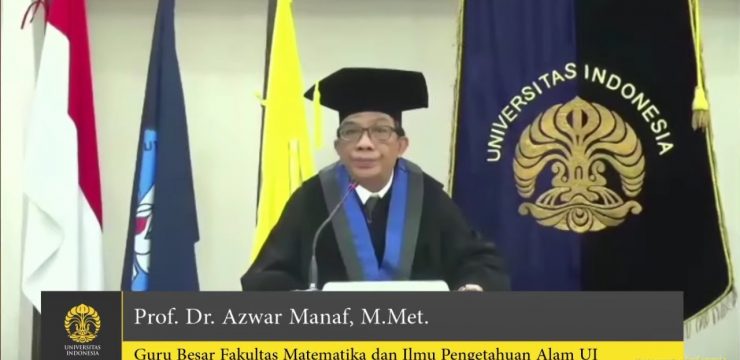
The Chancellor of the University of Indonesia (UI), Prof. Ari Kuncoro, S.E., M.A., Ph.D, inaugurated six UI professors in the Open Session of the Professor Inauguration Ceremony (GB). One of those inaugurated was Prof. Dr. Azwar Manaf, M.Met. from the Faculty of Mathematics and Natural Sciences (FMIPA) UI. The inauguration was carried out virtually on Saturday (10/04).
Prof. Azwar delivered an inaugural speech entitled “Rare Earth Metal Permanent Magnets: Their Role in the Era of the Fourth Zero Industrial Revolution”. He explained that the development of permanent magnet materials has been progressive since steel was first used as a permanent magnet in the 1900s. “The focus of research in this field is more on finding new materials that have a higher magnetic energy density. This activity has been going on for more than a hundred years with the discovery of rare earth metal (LTJ) magnets that have a magnetic energy density 68 times higher than steel magnets,” he said.
Prof. Azwar explained his ongoing research activities along with the development of technology to produce nanometer-sized structured materials. Since 2000, his research focus has shifted from searching for new materials to engineering material structures towards permanent magnets with an energy density of 1 MJ/m3 or 150 times higher than steel magnets. According to him, only LTJ permanent magnets have the potential to become high-energy magnets and thus become permanent magnets of the future.
Furthermore, Prof. Azwar explained that the nature of the very high energy density of LTJ magnets has the opportunity to create new designs with effective volume priority. This causes LTJ magnets to be widely needed by industry. Its use is distributed in various sectors, including the transportation sector (reaching 32%), the electricity industry which reaches almost 28%, especially in generator and electric motor applications.
“The role of LTJ in the era of the industrial revolution 4.0 has become one of the priority focuses of the national industry with the inclusion of the automotive industry and the electrical industry in the 5 priority industrial sectors towards Industry 4.0 in Indonesia. The era of the industrial revolution 4.0 is known as the era of artificial intelligence where humans rely more on machine capabilities including in industrial activities,” said Azwar. LTJ Magnet
highly capable, does not require large volumes to function effectively and can play an active role in meeting the needs of industrial technology 4.0 which prioritizes efficient and environmentally friendly performance.
In general, rare earth metals are found in the form of phosphate minerals, monazite, and xenotime. The rare earth metal content in monazite reaches almost 60%. Both types of minerals are found in several regions including Riau Province, North Sumatra, West Kalimantan, Central Sulawesi and West Sulawesi. The largest producer of rare earth in the world is China, controlling rare earth production up to 60%, followed by Australia at 12%. Indonesia is not included as a producer of rare earth metals that are taken into account. The electronics and automotive industry sectors that have become priority sectors should pay attention to the need for rare earth metals through the application of the circular economy principle can be an alternative to create added value in both sectors.
At the end of the speech, he conveyed about the processing based on the concept of reuse and recycling of rare earth metals that have been widely released in the 21st century. One of them is the recycling process of Neodymium and Dysprosium from used LTJ permanent magnets. LTJ permanent magnets contain more than 32% by weight of rare earth metal elements. In a product, LTJ material is present in quantities as low as 1 kg such as in electrical products, it can be as high as 1000 kg to 2000 kg in power generators and wind turbine generators. Based on the information above, it is quite clear that rare earth metal-based materials have enough potential for the application of a circular economy that focuses on the concept of the 5R process stages (Reduce, Reuse, Recycle, Recovery, Revalue) towards the creation of the industrial revolution 4.0.


