


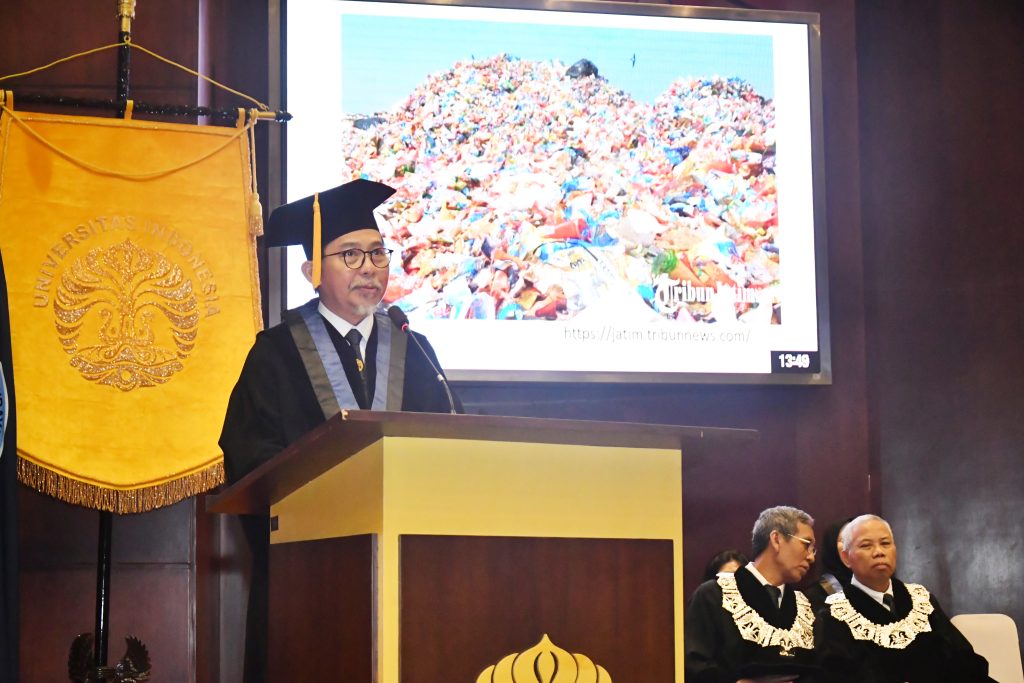
“Microplastics are a threat to our lives, not only in marine ecosystems, but also in freshwater. Our bodies can be ingested by microplastics when consuming fish, shellfish, or other aquatic organisms. This is worrying because microplastics in humans cause chromosomal changes that cause infertility, obesity, and cancer, as well as increasing immune responses.”
The statement by Prof. Dr.rer.nat. Mufti Petala Patria, M.Sc. was delivered in a scientific oration entitled “Microplastics: A Serious Problem in Our Seas”. At the Professor Inauguration Session led by the Chancellor of the University of Indonesia (UI), Prof. Dr. Ir. Heri Hermansyah, S.T., M.Eng., IPU, Wednesday (26/2), at the UI Convention Hall, he was appointed as a Permanent Professor of the Faculty of Mathematics and Natural Sciences (FMIPA) and became the 18th professor inaugurated this year from a total of 481 UI professors.

In his speech, Prof. Mufti explained that microplastics are plastic particles measuring less than 5 millimeters. Based on the source, microplastics are divided into two, namely primary microplastics and secondary microplastics. Primary microplastics are plastic measuring less than 5 mm in the form of pellets (granules) which are widely used for mixing cleaning products and cosmetics. Meanwhile, secondary microplastics are plastic waste that will decompose into smaller particles.
The form of microplastic particles is fiber, fragments, films, and granules. Microplastic fibers are shaped like threads that come from the degradation of fishing nets and fabric materials. Meanwhile, microplastic fragments, films, and foams come from the degradation process of plastic bags, packaging for daily necessities, or abrasion. Microplastics have a lower density than seawater, so they can float in water for quite a long time. However, due to reacting with chemical compounds or adhering to microorganisms, the density of microplastics increases and will sink and be stored in seabed sediments.
In his study, Prof. Mufti observed various studies related to microplastics. From the results of the study, he found that the microplastic content in the water and sediment in the Seribu Islands close to the coast of Tangerang—namely Untung Jawa Island (7 km away) and further away, Tidung Island (29 km away)—had changed.

“The amount of microplastics on islands far from the coast decreased by 12% in water and decreased by 20% in sediment. This means that microplastic pollution in the Seribu Islands originates from the coast of Jakarta and Tangerang. In addition, research at the same location with a one-year gap also showed an increase in the amount of microplastics. We conducted an examination of the sediments of Rambut Island in March 2022 and March 2023. The amount of microplastics in 2023 increased by 19.4% compared to 2022,” said Prof. Mufti.
According to him, microplastics in water or sediment can be eaten and sucked by animals or attached to macroalgae (seaweed) and seagrass. Marine biota often consider microplastics as food because they have a similar shape. Laboratory-scale research shows the negative impact of microplastics on marine biota, namely inhibited growth.
photosynthesis in algae; decreased appetite and fecundity; and decreased body weight, lysosome function in digesting food, and sperm diameter and velocity in oysters.
In addition to microplastics, nanoplastics are now widely found, which are plastic particles smaller than 100 micrometers. These particles can be absorbed by the intestines, flow with the blood in the blood vessels, and can spread to all organs, including the liver, kidneys, heart, placenta and brain. Therefore, the threat of microplastics in Indonesia needs to be mitigated with various steps, including being selective in choosing food, washing food, reducing the use of single-use plastics, managing plastic waste, and encouraging the government to create quality standards related to microplastics.

Prof. Mufti’s research on microplastics has also been conducted previously, including Vertical Distribution of Microplastic Along the Main Gate of Indonesian Throughflow Pathways (2024), Ingestion of Microplastics in the Planktonic Copepod from the Indonesian Throughflow Pathways (2024), and Sustainability Strategy for Turtle Conservation in Kelapa Dua Island, Kepulauan Seribu District, Jakarta, Indonesia (2024).
Thanks to his concentration on microplastic issues, Prof. Mufti was appointed as Professor of Ecology. Before being appointed as a professor, he completed his Bachelor’s degree in the Department of Biology, FMIPA UI in 1987, Master of Science in Coastal Management, Faculty of Science, University of Newcastle upon Tyne, England in 1991, and Doctor rerum naturalium, Zoologiesches Institut, Universitaet Hamburg, Germany in 2001. Currently, he serves as Chairman of the DKI Jakarta Commission of the Indonesian Oceanology Scholars Association (ISOI) and a Member of the Indonesian Academics and Scientists (ASASI).
The inauguration ceremony of Prof. Mufti was also attended by invited guests, including the Director of Intellectual Property Management of BRIN, Dr.-Ing. Muhammad Abdul Kholiq, M.Sc., IPU; Professor of the Faculty of Fisheries and Marine Sciences, IPB University, Prof. Dr. Ir. Neviaty Putri Zamani, M.Sc.; and CEO of Pandu Holding Company, Fajar Reza Budiman.


