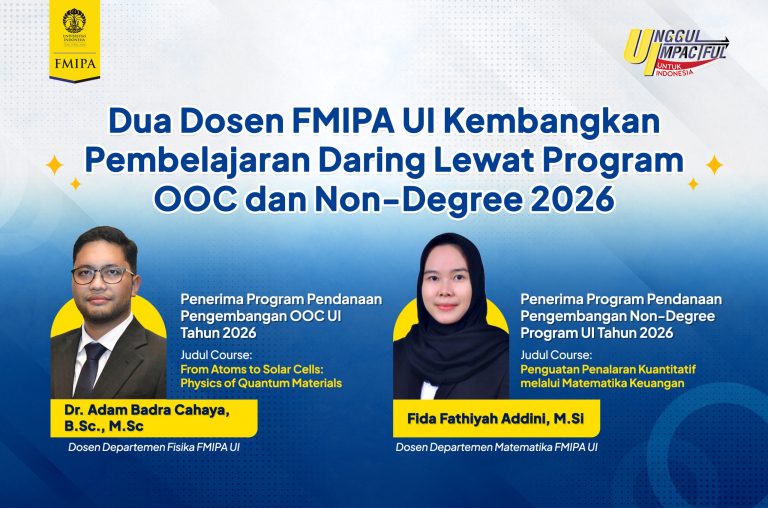
Two lecturers from the Faculty of Mathematics and Natural Sciences at the University of Indonesia (FMIPA UI) have successfully secured funding from the 2026 Open Online Course (OOC) Development Program and the Non-Degree Development Funding Program organized by the University of Indonesia.
They are Dr. Adam Badra Cahaya, B.Sc., M.Sc. from the Department of Physics and Fida Fathiyah Addini, M.Si from the Department of Mathematics. The announcement was also accompanied by an invitation to the 2026 UI Online Non-Degree Education Design Workshop.
Innovation in Modern Materials Physics Learning
Dr. Adam Badra Cahaya, B.Sc., M.Sc. is developing an OOC titled “From Atoms to Solar Cells: Physics of Quantum Materials” which explores modern materials physics based on quantum mechanics. According to him, the development of this learning program stems from the need to bridge fundamental physics concepts with contemporary technological applications.
“Understanding the quantum properties of materials is a crucial foundation for the development of various modern technologies,” said Dr. Adam. He added, “Through this course, we aim to show how concepts at the atomic level can evolve into innovations such as solar cells and sustainable energy devices.”
Furthermore, he emphasized that the learning approach is not only theoretical, but also connects classic experimental results such as crystal diffraction and atomic spectroscopy with energy band theory in materials physics. “Science becomes more meaningful when students understand the connection between experiments, theory, and real-world applications,” he said.
This course also reflects the strength of research within the Department of Physics at FMIPA UI, particularly in the fields of quantum materials physics, nanoscience, and green energy technologies, which continue to advance.
The target participants for this OOC include 11th–12th grade high school students with an interest in science and physics, undergraduate students from various disciplines—particularly science and engineering—as well as members of the general public who are interested in developments in science and energy technology. To take part in this course, participants are expected to have a basic understanding of high school-level physics and demonstrate an interest in science and technology.
Strengthening Quantitative Reasoning for the Younger Generation
Meanwhile, Fida Fathiyah Addini, M.Si is developing a Non-Degree program titled “Strengthening Quantitative Reasoning through Financial Mathematics” which is designed to strengthen the readiness of students and prospective university students for higher education.
“Financial mathematics was chosen because it is closely related to everyday life and is effective in training systematic thinking,” said Fida Fathiyah Addini, M.Si. She added, “The main objective of this program is to build participants’ confidence in understanding quantitative problems in a logical and structured manner.”
In her explanation, she emphasized that the learning is designed to be fully online with an approach that self-paced so that participants can learn flexibly. “We want participants not only to memorize formulas, but to truly understand the reasoning behind each calculation,” she said.
She also emphasized that mastering concepts such as interest, the time value of money, and annuities is not merely an academic skill, but also an essential foundation for making data-driven decisions in everyday life.
This Non-Degree program is designed to be inclusive so that it can reach a wide range of learners who wish to strengthen their quantitative skills before entering higher education. The target participants include 10th, 11th, and 12th grade high school students (or equivalent), high school graduates or gap year participants, as well as prospective university students and members of the general public who want to enhance their quantitative readiness before starting their studies.
Promoting Internationalization and Access to Education
Through this funding, the Faculty of Mathematics and Natural Sciences at the University of Indonesia (FMIPA UI) reaffirms its role in strengthening digital learning innovation at the university level. The development of OOC and non-degree programs is part of a strategic effort to expand access to quality education while also enhancing the global standing of the University of Indonesia.
Both programs are expected not only to serve as learning platforms for students and the general public, but also to become a medium for academic internationalization that showcases the strengths of FMIPA UI’s research and teaching to the global community. This initiative further underscores UI’s commitment to delivering education that is adaptive, inclusive, and relevant to the needs of the times.