


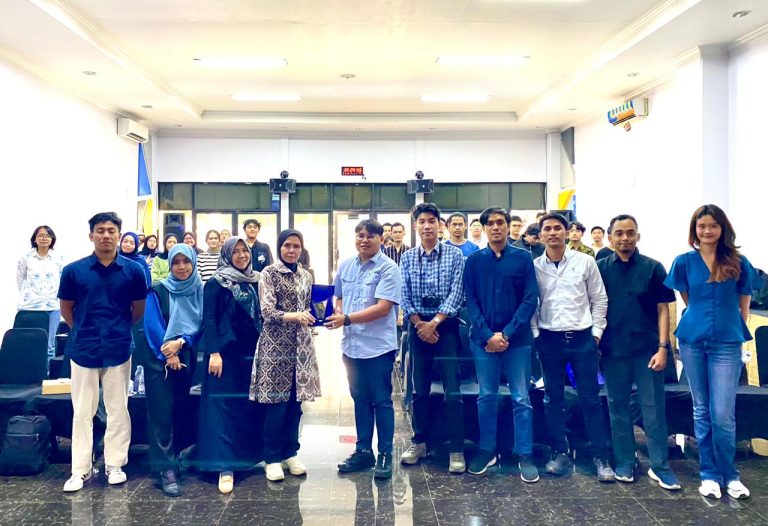
Depok, April 21, 2026 — Amid the growing global demand for energy and the increasingly complex challenges of resource exploration, mastery of geochemistry has become more crucial in supporting the accurate and efficient discovery of oil and gas reserves. Technology-based approaches and data analysis are now key to reducing exploration risks while increasing the success rate of identifying hydrocarbon potential.
In response to this urgency, the Faculty of Mathematics and Natural Sciences at Universitas Indonesia (FMIPA UI) held a weekly seminar titled the UI Geoscience Seminar x STARBORN MENGAJAR 2026 on Monday, April 20, 2026. The event took place at the Prof. Dr. G.A. Siwabessy Auditorium, UI Campus, Depok, and featured an industry practitioner as the main speaker.
This seminar featured Mona Ausiana Rachmalia, S.T., M.T., a Geochemistry Specialist and Lab Head Section at PT Geoservice. In her presentation, she discussed geochemistry-based oil and gas exploration methods, particularly using the Amplified Geochemical Imaging (AGI) approach.
“The AGI method provides a new, more sensitive way to detect hydrocarbon potential from the early stages of exploration,” she stated.
The material presented covered the principles of microseepage, passive sampling techniques using adsorbents, and high-precision laboratory analysis processes. “Through the microseepage approach, we can detect traces of hydrocarbons that were previously difficult to identify using conventional methods,” she explained.
In addition, the speaker explained the stages of data interpretation using various statistical methods such as PCA, HCA (clustering), LDA, and CVA to identify hydrocarbon potential. “The combination of statistical analyses is key to translating geochemical data into truly valuable information,” she added.
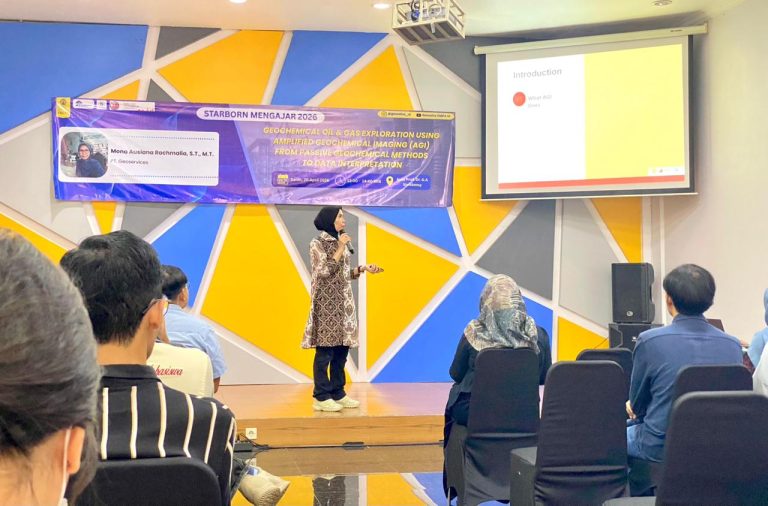
The seminar was not only a presentation but also interactive, featuring a Q&A session and a short quiz. The speaker posed several questions to participants regarding microseepage concepts and sampling tools, and awarded prizes to those who answered correctly.
In the subsequent session, Mona also highlighted technological advancements in this field. “The use of machine learning in the future will greatly help accelerate and enhance the accuracy of exploration data interpretation,” she stated.
The discussion also raised various critical questions from participants, including the interpretation of clustering results divided into six groups, the possibility of hydrocarbon potential that remains unclassified yet still prospective, and the application of machine learning in geochemical data analysis. In addition, the session explored the rationale behind selecting a sampling duration of around 21 days to obtain stable and representative data, as well as the qualifications required for interpreting AGI data.
As a closing, the speaker expressed her hope that the event would increase participants’ interest in the field of geochemistry. She also opened opportunities for further collaboration, such as knowledge-sharing sessions, laboratory visits in Petukangan, and internship opportunities for students.
Through this event, FMIPA UI hopes to continue providing scientific forums that not only enrich academic insight but also strengthen the connection between academia and industry.


