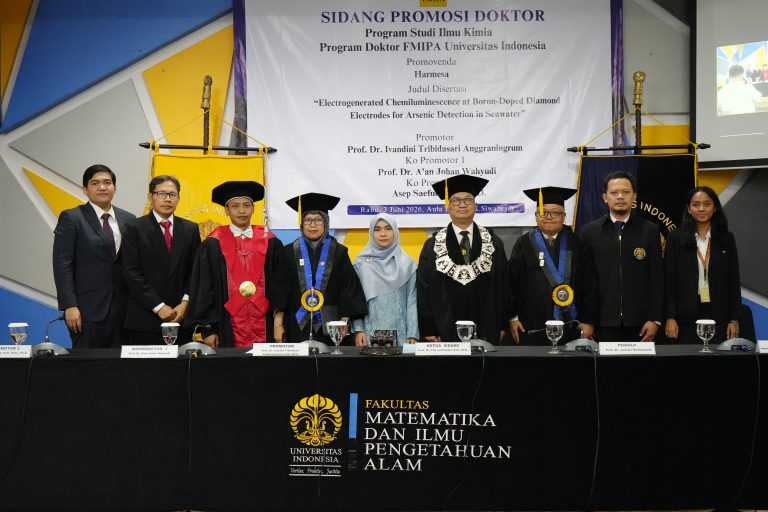
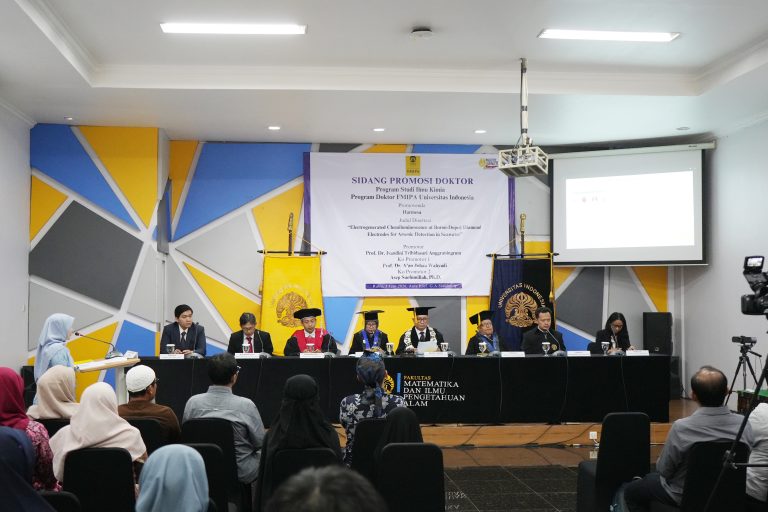
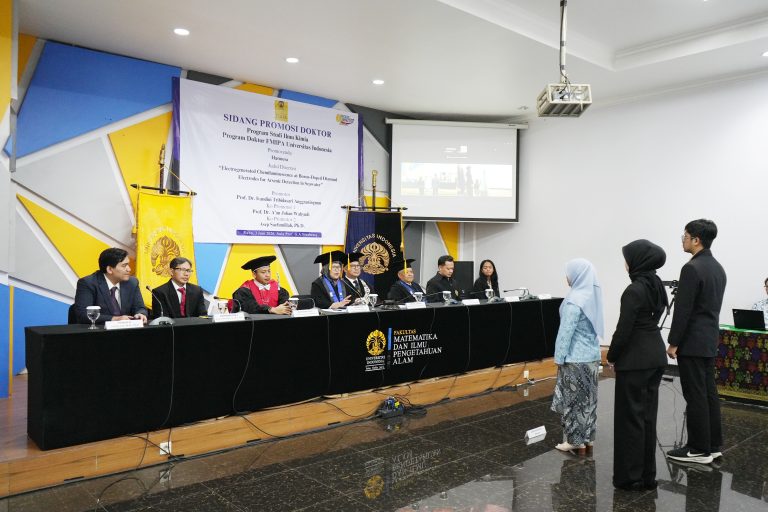
Depok, 8 Juni 2026 — Pengembangan teknologi deteksi arsenik yang lebih sensitif untuk mendukung pemantauan kualitas lingkungan perairan menjadi topik riset doktoral terbaru di Fakultas Matematika dan Ilmu Pengetahuan Alam Universitas Indonesia (FMIPA UI). Riset tersebut mengantarkan Harmesa meraih gelar doktor pada Program Studi Ilmu Kimia dalam sidang promosi yang digelar Rabu (3/6/2026).
During the doctoral promotion session held at the Prof. Dr. G.A. Siwabessy Hall, FMIPA UI, Depok, Harmesa defended his dissertation entitled Electrogenerated Chemiluminescence at Boron-Doped Diamond Electrodes for Arsenic Detection in Seawater. For this academic achievement, Harmesa successfully completed his doctoral studies in six semesters and graduated with the distinction of Summa Cum Laude.
The doctoral defense was chaired by Prof. Dr. Tito Latif Indra, S.Si., M.Si., Dean of FMIPA UI. Harmesa conducted his research under the supervision of Prof. Dr. Ivandini Tribidasari A., S.Si., M.Si. from FMIPA UI, Prof. Dr. A’an Johan Wahyudi from the National Research and Innovation Agency (BRIN), and Asep Saefumillah, S.Si., M.Si., Ph.D. from FMIPA UI.
The research focused on the development of an arsenic sensor based on electrogenerated chemiluminescence Electrochemiluminescence (ECL), an analytical method that utilizes light emission generated from electrochemical reactions to detect the presence of arsenic in aquatic environments. Arsenic is a hazardous metal that can cause serious health effects when accumulated over long periods; therefore, its presence must be monitored quickly and accurately.
In his research, Harmesa successfully developed a sensor using a boron-doped diamond (BDD) electrode.boron-doped diamond (BDD), which was modified with gold nanoparticlesgold nanoparticles or AuNPs). The modification was shown to significantly enhance the sensor’s sensitivity and detection capability compared to conventional electrochemical methods.
The research results demonstrated that the gold nanoparticle-modified BDD electrode was capable of detecting arsenic with higher sensitivity and an exceptionally low detection limit, reaching the nanomolar scale. The technology was also successfully applied to seawater samples, achieving a satisfactory level of accuracy.
According to Harmesa, the development of this method is expected to provide an alternative environmental monitoring technology that is more effective and affordable.
“Monitoring hazardous metals such as arsenic continues to face challenges in terms of analysis speed, sensitivity, and cost. Through the ECL approach that we have developed, we aim to provide a detection method that is not only more sensitive but also has the potential to be applied more broadly for environmental monitoring,” said Harmesa.
He added that the sensor technology developed is not only relevant for laboratory research purposes but also holds potential for further development into a field-deployable environmental monitoring device.
“As a maritime nation, Indonesia requires a reliable water quality monitoring system. The results of this research open opportunities for the development of sensors that can be used to rapidly detect hazardous contaminants, thereby supporting efforts to protect marine ecosystems and public health,” said Harmesa.
The study also compared two electrochemical measurement techniques, namely cyclic voltammetry-electrogenerated chemiluminescence (CV-ECL) dan anodic stripping voltammetry-electrogenerated chemiluminescence (ASV–ECL). The results showed that the ASV–ECL method exhibited significantly higher sensitivity due to the preconcentration of the analyte on the electrode surface prior to measurement.
Overall, the ECL-based approach developed in this study demonstrated superior sensitivity and selectivity compared with conventional electrochemical techniques. These findings further highlight the potential of advanced sensor technologies to support more effective monitoring of aquatic environmental quality.
This finding adds to the growing body of research in environmental monitoring technologies that are essential for supporting the management of Indonesia’s coastal and marine areas. As a maritime nation, Indonesia faces significant challenges in monitoring water quality, requiring analytical methods that are rapid, sensitive, and reliable.