Agricultural land in urban areas is increasingly limited, resulting in a shortage of space for agricultural cultivation. Furthermore, the limited yard space in densely populated areas is generally not optimally utilized to support family food security.
The terraced crop cultivation system is a greening concept suitable for densely populated residential areas with limited land.
With this background, the Community Service Team (Pengmas) from the Geography Department, Faculty of Mathematics and Natural Sciences, University of Indonesia (UI), partnered with Family Welfare Movement (PKK) cadres in Sukamaju Village, Cilodong District, to create and develop terraced cropping systems.
The Head of the Community Service Team, Dewi Susilowati, stated that the goal of the Pengmas program is to develop PKK cadres who understand, have compassion for, and are skilled in empowering local communities through terraced cropping systems.
“By developing this terraced cropping technology, it is hoped that participants will be able to utilize limited home environments to support their families’ food needs. In addition to transferring terraced cropping technology to the home environment, this activity also aims to create a clean environment and generate added value (income) from the products produced,” said Dewi.
Furthermore, he said, the community service aimed to increase the independence of the Family Welfare Movement (PKK) cadre groups that had been formed through collaborative, tiered vegetable planting.
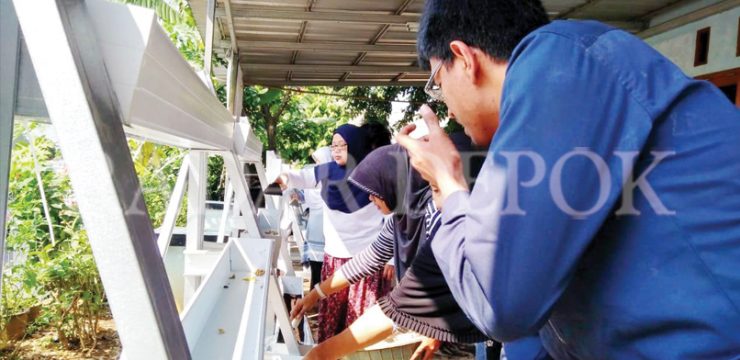
The community service team then created and developed tiered plantings in RT 02 and RT 07, RW 06, Sukamaju Village.
The types of vegetables chosen for cultivation were chili peppers, mustard greens, lettuce, kale, and basil. The participants enthusiastically participated in activities ranging from preparing the planting medium, sowing seeds, and planting the seedlings.
“We collaborated with the Depok City Department of Food Security, Agriculture, and Fisheries to discuss the Sustainable Food Home Area (KRPL) program,” he continued.
After the terraced planting practice, they continued with assistance in fertilizing and weeding.
Clumped plants were also thinned so they could be moved, preventing them from overlapping and allowing for optimal growth.
“The first harvest took place in September. The second harvest is planned for late October. With regular monitoring and mentoring, it is hoped that the objectives of this community service program will be achieved,” said Dewi.