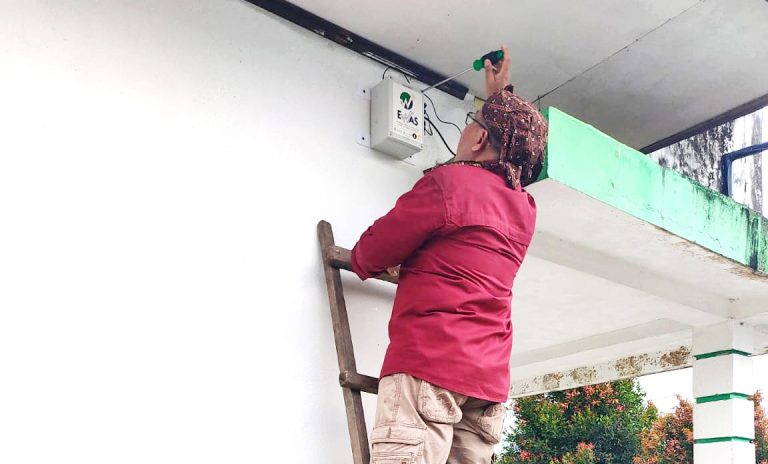
The recent extreme weather has prompted the government to take several preventive and mitigation measures, one of which is the operation of Weather Modification Technology (WMT). Quoting from an official press release by the National Research and Innovation Agency (BRIN), WMT is not new to Indonesia. Since 1977, the project—formerly better known as artificial rain—has already begun. The idea emerged when President Soeharto observed that agriculture in Thailand was quite advanced. Upon closer observation, it was found that Thailand’s agricultural progress was supported by water supply aided through weather modification.
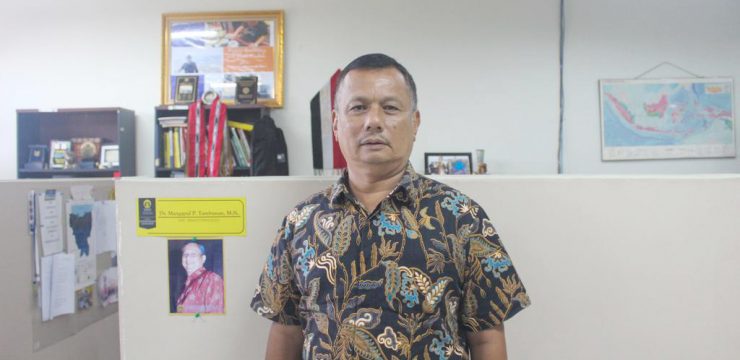
A lecturer from the Department of Geography, Faculty of Mathematics and Natural Sciences, Universitas Indonesia (FMIPA UI), and an expert in physical and environmental geography, Dr. Mangapul Parlindungan Tambunan, M.Si., said that Weather Modification Technology (WMT) is closely related to human interpretation technology in modifying naturally occurring weather. “Weather in a given event can include temperature, wind, and rain, which generally cover a limited area. For example, this occurs in a watershed (Daerah Aliran Sungai, DAS) and in a very dynamic region related to time. When we talk about weather modification technology, an example would be the weather in Jakarta, which tends to change over short temporal periods,” he explained.
According to Dr. Mangapul, talking about weather modification means discussing the hydrological cycle in the atmosphere. “When clouds are forming, that is where human interpretation comes into play. During condensation, clouds are seeded or dispersed so that rain occurs in the desired area,” he said. He views the purpose and benefit of conducting WMT operations as a way to accelerate the process of rainfall in targeted areas.
He also revealed that the success of WMT is influenced by the direction and strength of the wind. However, WMT operations can fail with an estimated probability of more than 50% when considering wind acceleration. “The chances of successfully controlling WMT are fifty-fifty. It mainly depends on the size of the area,” he added.
The operation of WMT works through a chemical process. Dr. Mangapul explained that after salt is dispersed using an aircraft that carries the salt into the air and seeds it over a predetermined area, this can accelerate the occurrence of rainfall. “Meanwhile, WMT operations are conducted by observing cloud conditions. Before rain occurs, the process aims to redirect it to the desired area, such as over the sea, by calculating the expected rainfall intensity in a specific area,” he said.
In addition to the Meteorology, Climatology, and Geophysics Agency (BMKG); the National Research and Innovation Agency (BRIN); the Air Force; and other agencies, scientists and academics need to be involved in accelerating the calculation of weather movements such as rain or current extreme weather. Dr. Mangapul stated that the involvement and collaboration of various parties, especially government institutions, can be widely utilized for the benefit of society.
“Starting from the objectivity of natural science, research methods, field data, and institutional data, collaboration among various parties is necessary with the goal of nation-building. BMKG provides weather forecast reports to the Department of Geography at FMIPA UI, and then FMIPA UI conveys research results and recommendations to the government. An example of institutional data is if every district or subdistrict has wind and rainfall measuring instruments, both conventional and modern, such as the use of radar, which facilitates BMKG in obtaining weather-related data,” said Dr. Mangapul.
According to him, no negative impacts from the current WMT operations have been found. “Because previously, WMT operations have been tested in several countries and are now used in Indonesia. The effectiveness rate of WMT operations can be said to be 50% successful and 50% unsuccessful. This largely depends on the wind (its speed and strength),” he said.
“Weather is something we need to be grateful for. How we manage weather phenomena to coexist harmoniously with the weather is by learning, understanding, and studying specific weather conditions so that it becomes an effort to prepare ourselves in facing extreme weather events,” said Dr. Mangapul.
Water areas such as watersheds (DAS) must be utilized because they play an important role in preserving the environment and providing water needs for the community. Watershed management must be integrated from upstream to downstream to prevent disasters from occurring in the upstream, middle, or downstream parts of the watershed.
He hopes that the public today also needs to be aware of and pay attention to the biggest or dominant factor causing extreme weather, which is anthropogenic. Anthropogenic activities are those that produce pollution, such as factory waste, transportation pollution, illegal logging, palm oil plantation expansion, and natural factors like volcanic activity. “One effort that can be made to minimize these impacts is by planting tropical plants or vegetation in open land,” said Dr. Mangapul.