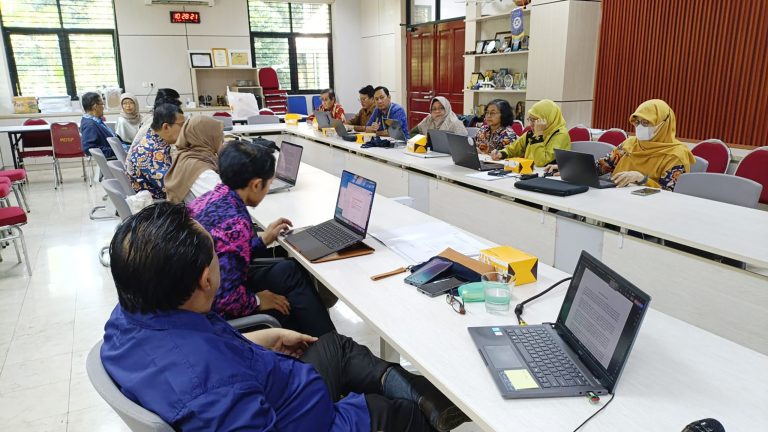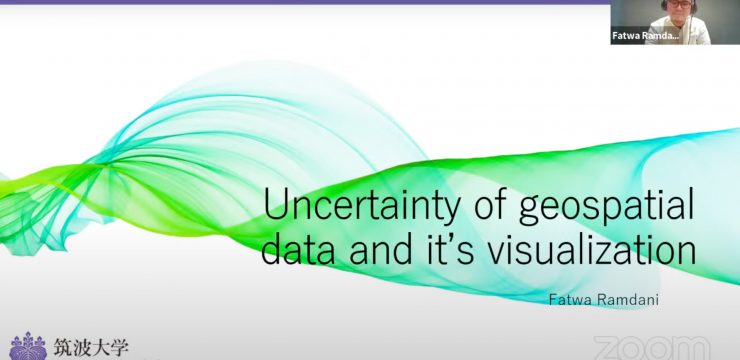
Today, Friday (4/22/2022). The Faculty of Mathematics and Natural Sciences (FMIPA UI) is again holding the MIPAtalk Series webinar. The webinar entitled “Uncertainty of Geospatial Data and Its Visualization” is the third series of MIPAtalk webinars.
In the agenda of the third MIPATalk Series, Dr. Fatwa Ramdani, S.Si., M.Sc. who is a Graduate School of Humanities and Social Studies, University of Tsukuba, Japan, as a resource person and Iqbal Putut Ash Shidiq, M.Sc. Head of the Geography Undergraduate Study Program, FMIPA UI as a moderator. The third MIPAtalk series is still held through the Zoom Meeting platform and broadcast live through the official FMIPA UI Official YouTube channel.
Vice Dean for Resources, Ventures and General Administration of FMIPA UI, Dr. Tito Latif Indra, M.Si. opened the event. In his speech, Dr. Tito said, “The MIPAtalk Series activity is a commitment of FMIPA UI in realizing the improvement of scientific insight in various disciplines, especially sciences such as geography, geoscience, mathematics, physics, chemistry and biology.”
“This activity, God willing, will be held every two weeks with the latest topics from various disciplines of science. Through this activity, we really hope to provide more up-to-date scientific insights, not only to lecturers but also to students,” continued Dr. Tito in his speech. He also hopes that this activity will provide opportunities for wider collaboration between participants.
Entering the main session, namely the presentation of Dr. Fatwa Ramdani, S.Si., M.Sc. as the keynote speaker, in his presentation Dr. Fatwa who is a lecturer and researcher at the Graduate School of Humanities and Social Studies, University of Tsukuba, Japan explained that of the many data widely spread on the internet, more than 80 percent of the data is related to location.
Explained through image examples, much graphic information that is consumed by the public cannot be identified as valid. Furthermore, he explained that the journey of data starts from raw data, then is sorted, arranged, visualized, explained using stories, until it becomes acceptable data.
The level of data uncertainty from low to high goes hand in hand with the data journey. The public must be critical of the data and information presented in the public space.
“Uncertainty is a state of uncertainty, doubt, confusion, and unpredictability. Geospatial describes a relative position, ‘something’ on the surface of the earth. Data is the plural form of datum, which is often used in statistical, mathematical, and geographical studies. Visualization is an attempt to describe a technique that involves various approaches to then visualize something to achieve a certain goal,” explained Dr. Fatwa dissecting the meaning of the title of his material word by word.
The Geoinformatics (GIS), Machine Learning, Applied Data Science expert also emphasized that the thing that must be considered to reduce uncertainty is the need to be careful with data sources.
“Never fully trust data whose metadata is unclear. Never use geospatial data from sources that do not have a good and clear geospatial data reputation. Never use data if there is no quality control information. Finally, do a comparison, compare the data you already have with data from other sources,” he said.
There are four strategies to reduce geospatial data uncertainty. First, determine the needs first. Second, select and sort the best quality data. Third, minimize the impact. Then finally, make a decision to accept or reject the uncertainty. If you reject the uncertainty, go back to point number two.
“Geospatial data can contribute to the decision-making process. But then there is something called uncertainty, which is a logical consequence that arises from the complexity of real-world phenomena. We will never be able to reconstruct the reality in the real world into the digital world with 100 percent accuracy. Uncertainty its representation cannot be separated from cultural, political, social, linguistic values, it plays an important role. Uncertainty we can’t avoid it. However, we can minimize it,” said the alumni of the UI FMIPA Geography bachelor’s degree as a conclusion of the material.