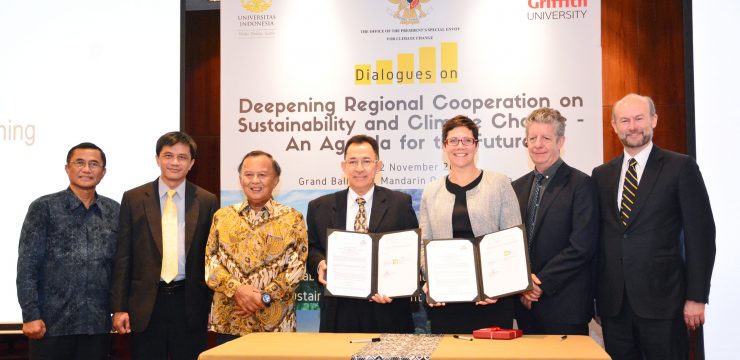
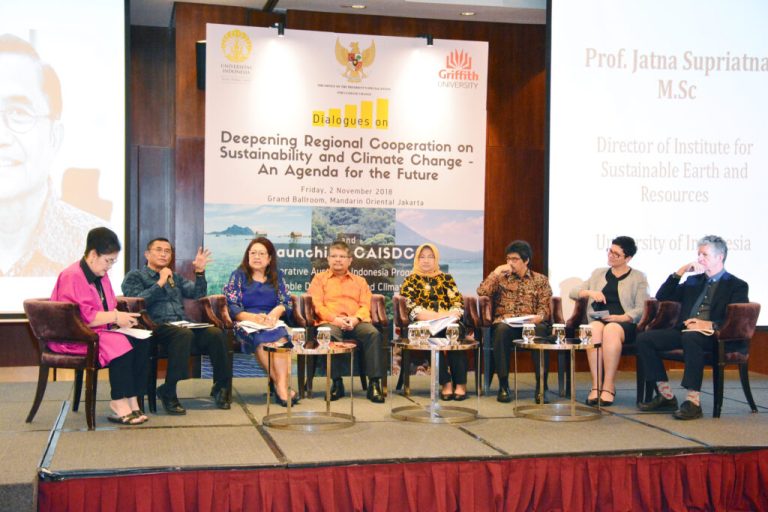
In the context of research related to climate change and sustainable development, the University of Indonesia (UI) is collaborating with Griffith University from Australia. The collaboration established in the program Collaborative Australia-Indonesia Program on Sustainable Development and Climate Change (CAISDCC) ini telah resmi diluncurkan pada Jumat, 2 November 2018 di Hotel Mandarin Oriental, Jakarta.
The inauguration ceremony was attended by Prof. Dr. Ir. Muhammad Anis, M. Met. (Rector of UI), Prof. Caitlin Byrne (Director Griffith Asia Institute, Griffith University), Gary Quinlan AO (Australian Ambassador to Indonesia), Prof. Rachmat Witoelar (Special Presidential Envoy for Climate Change Control), and Prof. Jatna Supriatna, M.Sc.,Ph.D. (Director Institute for Sustainable Earth and Resources UI).
The collaboration consists of several focuses, namely high-level dialogue between the two countries; research collaboration; support for research, mentoring, and capacity building; and student exchange between the two countries..
Through this collaboration, UI is represented Institute for Sustainable Earth and Resources (I-SER) dan Griffith University yang diwakili Griffith Asia Institute, is expected to produce a number of joint research between Indonesia and Australia and produce science-based policy recommendations in the field of climate change and sustainable development.
The government will provide input and receive the results of the study. This is crucial to helping Indonesia achieve its national greenhouse gas emission reduction target of 29% by 2030, or up to 41% with international cooperation.
Prof. Dr. Ir. Muhammad Anis, M.Met., Rector of the University of Indonesia, stated that Indonesia and Australia have collaborated in science and innovation for years. The two countries share a unique bond as neighbors at the maritime crossroads of the Indian and Pacific Oceans.
UI’s involvement in the CAISDCC collaboration demonstrates its support for the Indonesian Government’s efforts to combat climate change. As a factory of knowledge and expertise, UI is expected to provide innovative input and solutions regarding the sustainable development issues facing both countries.
Echoing Anies, Prof. Dr. Jatna Supriatna, Chair of the Institute for Sustainable Earth and Resources (I-SER), stated that cooperation in addressing sustainable development and climate change issues is essential. Neither country can work alone. The long-term collaboration between the two countries across various sectors needs to be refreshed periodically to meet the evolving needs of the region, especially in this era of unpredictable climate change.
A Glance at I-SER
The Institute for Sustainable Earth and Resources (I-SER) was established based on Indonesia’s commitment and the University of Indonesia’s vision to become a “World-Class Research University” through science and research. I-SER was established to address sustainable development issues based on science and research.
Academics, scientists, and practitioners play a vital role in explaining the facts, creating, and developing solutions to help address the complex dimensions of climate change and the fundamental needs of sustainable development from upstream to downstream.
In its work, I-SER adopts the 17 United Nations Sustainable Development Goals, addressing the need to address global temperature rise through sound, integrated science. By integrating our understanding of tropical islands from various disciplines, we seek science-based global environmental solutions to support sustainable development in tropical regions.
As a forum for academics and practitioners, I-SER, under the Faculty of Mathematics and Natural Sciences, University of Indonesia (FMIPA UI), plays a vital role in disseminating the knowledge and skills needed to promote sustainable consumption and production patterns and to improve the management of natural resources and agriculture. For this reason, I-SER also adopted the importance of developing the Quadruple Helix between government, society, industry, and academia, because understanding these four pillars is very important to be combined together in supporting the implementation of sustainable solutions.