


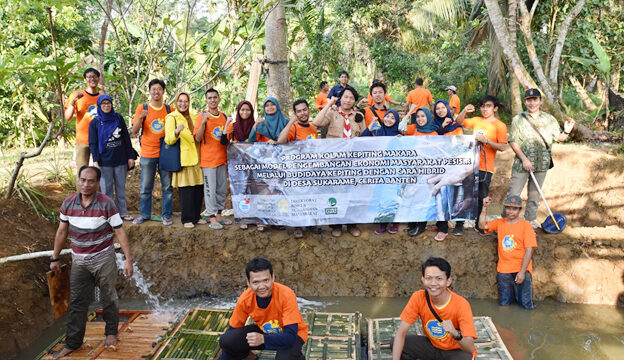
Sukarame Village, Carita, Pandeglang, Banten, was one of the areas affected by the Sunda Strait tsunami at the end of 2018. The community largely relies on tourism for its livelihood. The decline in tourist arrivals to Carita has had a direct impact on their well-being.
With this background, on July 23-26, 2019, the Community Service Team (Pengmas) of FMIPA UI consisting of 4 lecturers, namely Dimas Haryo Pradana as team leader, Retno Lestari, Mufti Petala Patria, and Anom Bowolaksono, with 2 assistants, and 20 students departed for Sukarame Village, Carita, Pandeglang Banten, in order to implement a community service program based on science and technology to develop a makara crab pond as a model for developing the economy of coastal communities through crab cultivation.
In this program, the FMIPA UI Community Service Team collaborates with the Pandu Cendekia Foundation, and is supported by the Directorate of Research and Community Service of the University of Indonesia (DRPM UI).

Dimas Haryo Pradana explained that makara crab ponds can be promoted as a model for empowering coastal communities by prioritizing existing areas. The combination of vertical and horizontal systems in makara crab ponds will promote efficiency and effectiveness, while also encouraging sustainable economic growth in coastal areas.
“The stages of the makara crab pond activities include seeding, making feed based on regional potential, introducing minatorporter technology, and introducing technology to convert mangrove crabs into soft-shell crabs, which are more in demand and have good export potential,” said Dimas.
To ensure sustainability, this community service program is implemented by involving residents from the construction of ponds, crab media, breeding, maintenance, to harvesting activities in accordance with the established SOPs.
Didi, the neighborhood association (RT) head and community leader, expressed his gratitude for the Makara Crab Pond program in his village. He explained that this program would significantly impact the local economy. He hopes the program can be sustainable and expanded to include other commodities, such as shrimp and fish.
This is in line with what was expressed by the chairman of the Pandu Cendekia Foundation, Fajar R. Budiman, who explained that, “The existence of the Makara Crab Pond is expected to help provide an alternative model for sustainable coastal area development, increase employment opportunities for the people of Sukarame Village and its surroundings, and become one of the tourist destinations in Carita that is able to attract tourists to Carita.” Said Fajar.


