


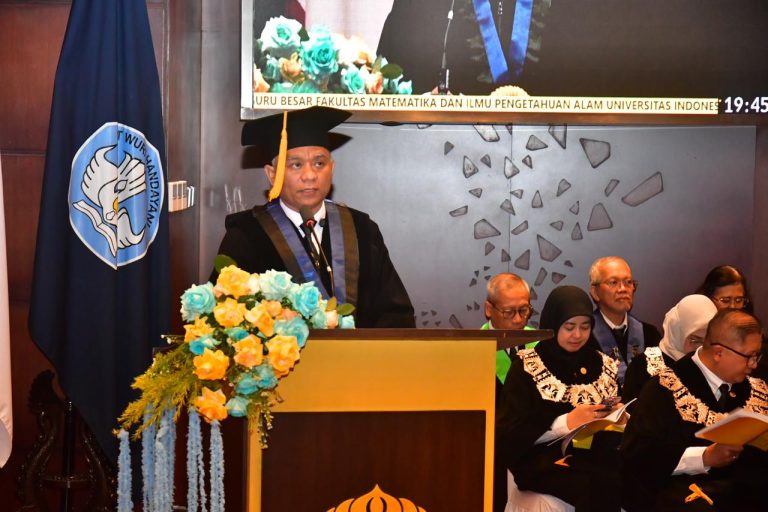
A Professor at the Faculty of Mathematics and Natural Sciences, Universitas Indonesia (UI), Agustino Zulys, highlighted the importance of developing Metal Organic Framework (MOF) as an advanced material with broad potential across various fields, ranging from healthcare and renewable energy to catalysis industries and environmental remediation.
The statement was delivered during his inaugural speech as a Permanent Professor at the Faculty of Mathematics and Natural Sciences, Universitas Indonesia, in the field of Chemistry—specifically Coordination Chemistry, Homogeneous Catalysis, and Organometallic Synthesis—on Saturday, April 11, 2026, at the Balai Sidang Universitas Indonesia. The inauguration ceremony was led by the Rector of UI, Heri Hermansyah.
In a speech titled The Usefulness of Useless MOF (Metal Organic Framework) for Sustainable Green Energy, Agustino Zulys emphasized the importance of strengthening basic science research as the primary foundation for technological development. He noted that the current state of basic science research in Indonesia remains relatively weak, while expectations for technological outcomes and applications are very high—creating an “inverted cone” phenomenon with an unstable foundation.
According to Agustino Zulys, MOFs were initially considered “useless” materials because they could not outperform materials such as zeolite in terms of adsorption or catalysts in thermal stability. However, as global research has advanced, these materials have instead demonstrated extraordinary potential.
“As long as we conduct research, nothing is ever in vain,” said Prof. Zulys.
He explained that the development of Metal Organic Framework (MOF) has progressed rapidly, driven in part by the research of Omar M. Yaghi and Susumu Kitagawa. These materials are now utilized as catalysts for chemical production, as photocatalysts to remove heavy metals from water pollution, and to reduce carbon levels through selective separation and adsorption processes. With a surface area reaching 7,000–8,000 m² per gram, MOFs are also considered highly promising as efficient gas storage media.
The highly ordered and flexible structure of Metal Organic Framework (MOF) makes it one of the leading candidates for future technology development in the fields of energy, environment, and healthcare.
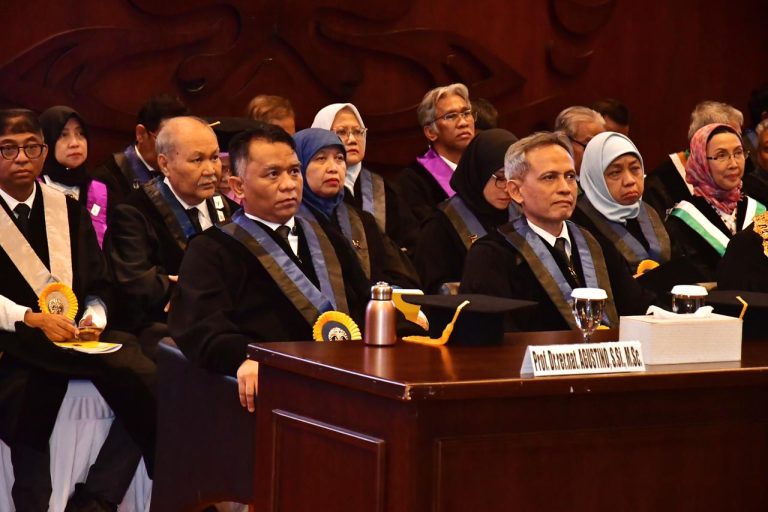
Furthermore, Agustino Zulys highlighted the challenges in developing alternative energy, particularly hydrogen production through the process of water splitting. He explained that the water hydrolysis process has so far been considered inefficient, as the energy required is significantly greater than the energy produced.
To address this issue, Agustino Zulys emphasized the importance of utilizing solar energy as the input energy source, so that the process can be categorized as green energy.
“Hydrogen as a fuel produces water as its final product, meaning it does not generate carbon,” he explained.
In supporting MOF research, Agustino Zulys emphasized the need for advanced characterization instruments, such as Fourier Transform Infrared Spectroscopy (FTIR), X-ray diffraction (XRD), X-ray photoelectron spectroscopy (XPS), scanning electron microscopy–EDX, thermogravimetric analysis (TGA), as well as X-ray crystallography.
“Alhamdulillah, we have already developed two bio-MOF structures that have been successfully synthesized,” he said.
He also highlighted the next challenge, namely the storage of hydrogen gas as a fuel, which requires materials with high adsorption capacity, such as Metal Organic Framework (MOF).
“Imagine, we are no longer just discovering materials in nature, but creating new structures with the functions we desire,” said Agustino Zulys.
In advancing his research, the team led by Agustino Zulys has collaborated with various institutions and research groups to explore a wide range of Metal Organic Framework (MOF) applications, including catalysis, organic transformation, and carbon capture and utilization (CCU), drug deliveryas well as heavy metal adsorption and photocatalysis for dye degradation.
On that occasion, he specifically highlighted the significant potential of applications water splitting sebagai sumber energi alternatif masa depan.
In closing his speech, Agustino Zulys emphasized that the future of global energy will be determined not only by energy sources, but also by humanity’s ability to engineer systems capable of efficiently converting, storing, and utilizing energy.
He added that Metal Organic Framework (MOFs), particularly those based on lanthanides, open a new paradigm in catalyst design—from merely passive materials to molecular architectures that can be engineered to control energy reactions at a fundamental level.
“If hydrogen is the energy of the future, then catalysts are its heart, and materials engineering is the key,” he emphasized.
“From invisible atomic structures to the future of human energy, science teaches us that great solutions often arise from the most fundamental engineering,” concluded Agustino Zulys.


