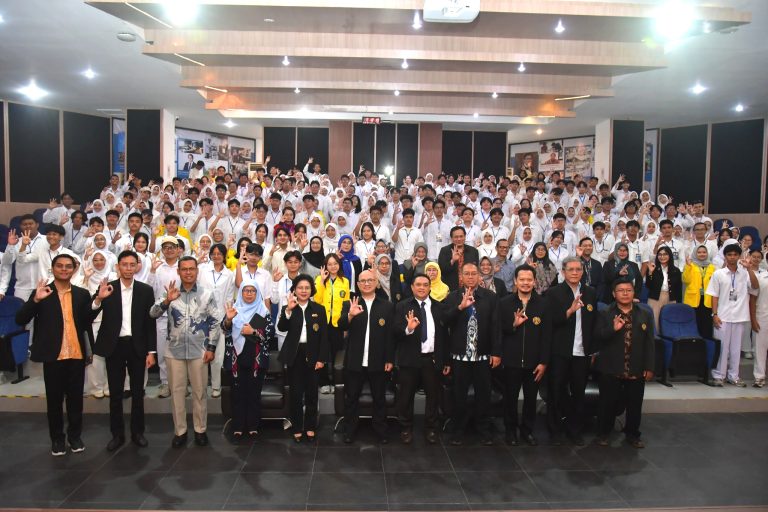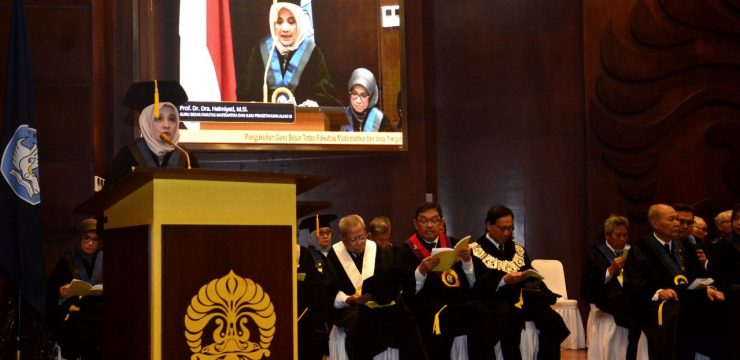
The Chancellor of the University of Indonesia (UI), Prof. Ari Kuncoro, S.E., M.A., Ph.D., inaugurated Prof. Dr. Dra. Helmiyati, M.Si. as a Permanent Professor in the Field of Polymer Physical Chemistry, Department of Chemistry, Faculty of Mathematics and Natural Sciences (FMIPA) UI. The inauguration ceremony was held on Wednesday (9/8), at the UI Depok Campus Convention Hall. On that occasion, Prof. Helmiyati presented the results of her research entitled “Potential of Biopolymers and Nanoparticles as Functional Green Nanocomposites: Energy, Clean Water, and Health”.
In her scientific speech, Prof. Helmiyati stated that Indonesia is rich in chemical materials sourced from natural resources. Seeing this potential, she developed a biopolymer-based Nanocomposite synthesis supported by metal oxides for application to various needs. The incorporation of metal nanoparticles or metal oxides on the surface of the biopolymer will produce nanocomposite properties that are superior to each material and are synergistic. This finding can be developed as a catalyst for biodiesel; as a photocatalyst for handling hazardous dye waste so that clean water is obtained; and as an antibacterial that is useful in the health sector.
According to Prof. Helmiyati, fuel is a crucial factor in economic development because it is used in various types of vehicles, such as cars, motorcycles, trains, and airplanes. The fuels currently used are largely derived from fossil fuels. The use of fossil fuels causes serious environmental problems, as their combustion produces greenhouse gases and depletes fossil fuel resources. Global fuel use is expected to increase by 28% between 2015 and 2040.
To address these issues, environmentally friendly and renewable alternative fuels are needed. Biodiesel, or fatty acid methyl ester (FAME), is considered a suitable fuel substitute because it can be directly substituted or blended with diesel fuel; it has lower greenhouse gas emissions, a better cetane number, and a low sulfur content; and it is non-toxic. Furthermore, biodiesel can be prepared using readily available materials, such as palm oil, coconut oil, soybean oil, animal fat, and used cooking oil.
In addition, nanocomposites can also be used as photocatalysts to degrade dyes in wastewater to obtain clean water. Large amounts of dye waste generated from various industries, such as textiles, plastics, paper, food, and cosmetics, cannot be disposed of without adequate treatment. This is because dye pollutants from industry are one of the main causes of ecological system pollution. Even in small amounts, dye pollutants can be very toxic because they have a complex structure, making them difficult to degrade.
Azo dyes are a group of organic compounds found in dyes that can produce carcinogenic aromatic amines, such as benzidine, 3,3-dimethylbenzidine, 3,3-dimethioxybenzidine, and 2,4-toluylethylenediamine. These compounds can cause cancer and almost 70% of synthetic dyes contain azo groups. This is because synthetic dyes are resistant to light, acids, and alkalis. Therefore, the use of metal oxide semiconductor materials is useful as catalysts in photocatalysis because they have high stability, are available in nature, and are non-toxic.
Zirconium oxide semiconductor is a suitable material for photocatalysis with the advantages of non-toxicity, high stability, low cost, low thermal conductivity, insolubility in water, high catalytic activity, and optical properties. Zirconium oxide is stable, hydrophilic, produced at low cost, and is a semiconductor with a band gap of 5.0 – 7.0 eV which means it is in the UV light region. One method to reduce the band gap energy and increase photocatalytic activity is doping with semiconductors that have a small/narrow band gap energy.
In the healthcare sector, nanocomposites are used as antibacterial materials, such as wound healing hydrogels, antibacterial fabrics, and food packaging. Antibacterial materials are crucial, especially in the post-pandemic era. Petroleum-based plastics are a frequently used packaging material due to their wide availability and low cost. However, their continued use can lead to reduced availability, the creation of non-biodegradable waste, and environmental pollution.
Food packaging with biopolymer-based nanocomposite films is one solution to reduce plastic waste, particularly waste generated by the food industry. Food packaging with biopolymers is biodegradable, including carbohydrates, proteins, lipids, and their composites. Sources of biopolymers include natural biopolymers, microbial biopolymers, and biodegradable synthetic polymers. Natural biopolymers include starch, chitosan, cellulose, and carbohydrate derivatives.
“The combination of naturally occurring nanoparticles and biopolymers can be utilized to provide safe and affordable materials as an alternative source of new energy from renewable sources. More efficient and environmentally friendly technologies are also needed to process waste to produce clean water. Furthermore, environmentally friendly antibacterial materials need to be developed to improve environmental quality and thus improve public health,” said Prof. Helmiyati.
This research is one of many studies conducted by Prof. Helmiyati. Some of her published papers include Magnetic Alginate–Carboxymethyl Cellulose to Immobilize Copper Nanoparticles as a Green and Sustainable Catalyst for Nitrophenol Reduction (2023); Green Hybrid Photocatalyst Containing Cellulose and γ–Fe2O3–ZrO2 Heterojunction for Improved Visible-Light Driven Degradation of Congo Red (2022); and Antimicrobial Packaging of ZnO–NPs Infused into CMC–PVA Nanocomposite Films Effectively Enhances the Physicochemical Properties (2021).
Prof. Dr. Dra. Helmiyati, M.Sc. has studied Bachelor of Chemistry, Field of Physical and Analytical Chemistry, Andalas University (1981–1986); Master of Science in Chemistry, Field of Physical Chemistry, Bandung Institute of Technology (1987–1989); and Doctorate in the Field of Physical Chemistry of Polymers, Chemistry Study Program, UI (2006–2009). The inauguration ceremony of Prof. Helmiyati was also attended by Retired Professor of the Chemistry Department of FMIPA UI, Prof. Dr. Wahyudi Priyono Suwarso; Dean of FMIPA UI for the 1994–1998 period, Prof. Dr. Endang Asijati, M.Sc.; Head of the 2nd Chemistry Department of FIPIA UI for the 1964–1967 period, Dr. Ir. Matulanda Ratulangi Sugandi; and Secretary of the 2nd Chemistry Department of FIPIA UI for the 1964–1967 period, Drs. F. Santoso.