Depok, April 15, 2026 — Amid the increasing demand for tropical fruit exports to global markets, ensuring product safety and quality has become a crucial aspect. One internationally recognized method for ensuring that fruits are free from plant pests is phytosanitary irradiation. However, the effectiveness of this method heavily depends on accurate radiation dose measurement.
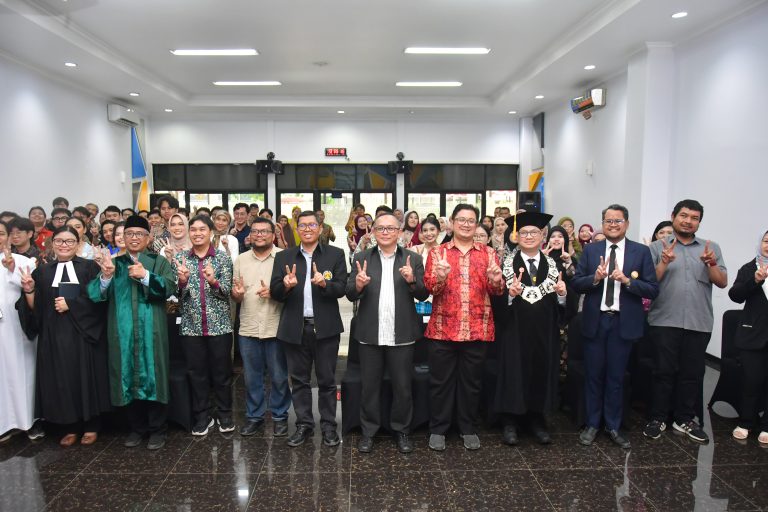
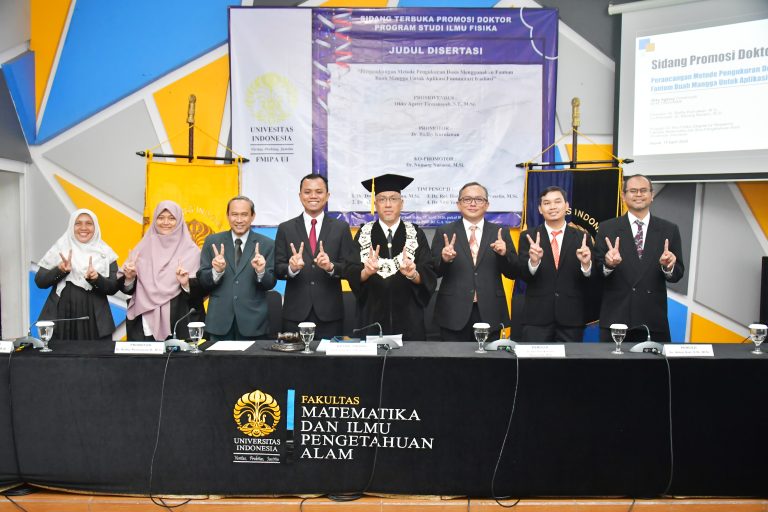
To address this challenge, a doctoral graduate from the Faculty of Mathematics and Natural Sciences, Universitas Indonesia (FMIPA UI), developed a radiation dose measurement method based on a 3D-printed mango phantom, which was presented in the open doctoral promotion examination on Wednesday (April 15) at the Prof. Dr. G.A. Siwabessy Auditorium, FMIPA UI Depok campus.
In the session, Dr. Okky Agassy Firmansyah from the Physics Study Program at FMIPA UI presented his dissertation titled “Development of a Dose Measurement Method Using a Mango Phantom for Phytosanitary Irradiation Applications.” The examination session was chaired by Prof. Anom Bowolaksono, Ph.D., Vice Dean for Education, Research, and Student Affairs at FMIPA UI.
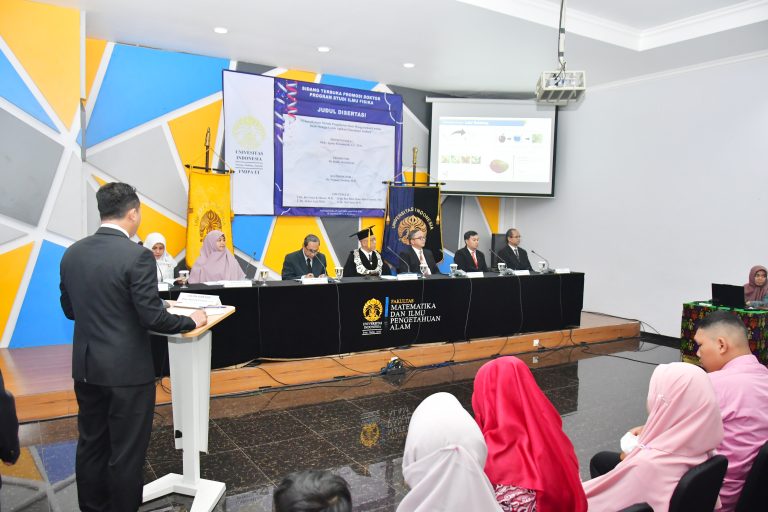
This research was supervised by Promoter Dr. Budhy Kurniawan R., M.Si. from the Department of Physics, FMIPA UI, and Co-promoter Dr. Nunung Nuraeni, M.Si. from the Center for Research in Safety Technology, Metrology and Nuclear Quality, Nuclear Energy Research Organization, National Research and Innovation Agency.
In his presentation, Dr. Okky explained that the use of real fruit in irradiation testing is often constrained by seasonal availability as well as difficulties in obtaining consistent measurement results. To address this, he developed a “synthetic mango” based on 3D printing technology that mimics the physical and radiological characteristics of a real mango.
“This 3D-printed mango phantom was developed to address the limitations of using real fruit in radiation dose measurements,” said Dr. Okky.
He added that this method enables testing to be conducted more stably and reproducibly, with consistent results without depending on harvest seasons.
The research results show that dose measurements on real mangoes and the phantom exhibit very good agreement, with a relative deviation of less than ±2 percent and an En number below one, indicating that the method is valid in terms of dosimetry and metrology.
The developed phantom has characteristics close to those of a real mango, including a mass density of 1.2 g/cm³, an effective atomic number (Zeff) 7.5, and a relative electron density of 0.984. In addition to experiments, this study also utilized Monte Carlo simulations to map the radiation dose distribution within the fruit computationally.
The research promoter, Dr. Budhy Kurniawan R., M.Si., described this approach as an important breakthrough in the development of more precise and reliable dose measurement systems.
“The use of a phantom validated through both experiments and simulations opens up great opportunities to improve quality control in irradiation facilities,” he said.
In the session, Dr. Okky Agassy Firmansyah officially earned his doctoral degree from FMIPA UI with summa cum laude distinction. He achieved a perfect GPA of 4.00 and completed his studies in a relatively short period of 2.5 years. In addition, during his studies, Dr. Okky produced three publications in reputable international journals as part of his scientific contributions in the field of physics and irradiation technology.
This research is expected to serve as an applicable solution in the food irradiation industry, both in improving testing efficiency, reducing dependence on fresh fruit, and supporting stricter safety standards for export products.